
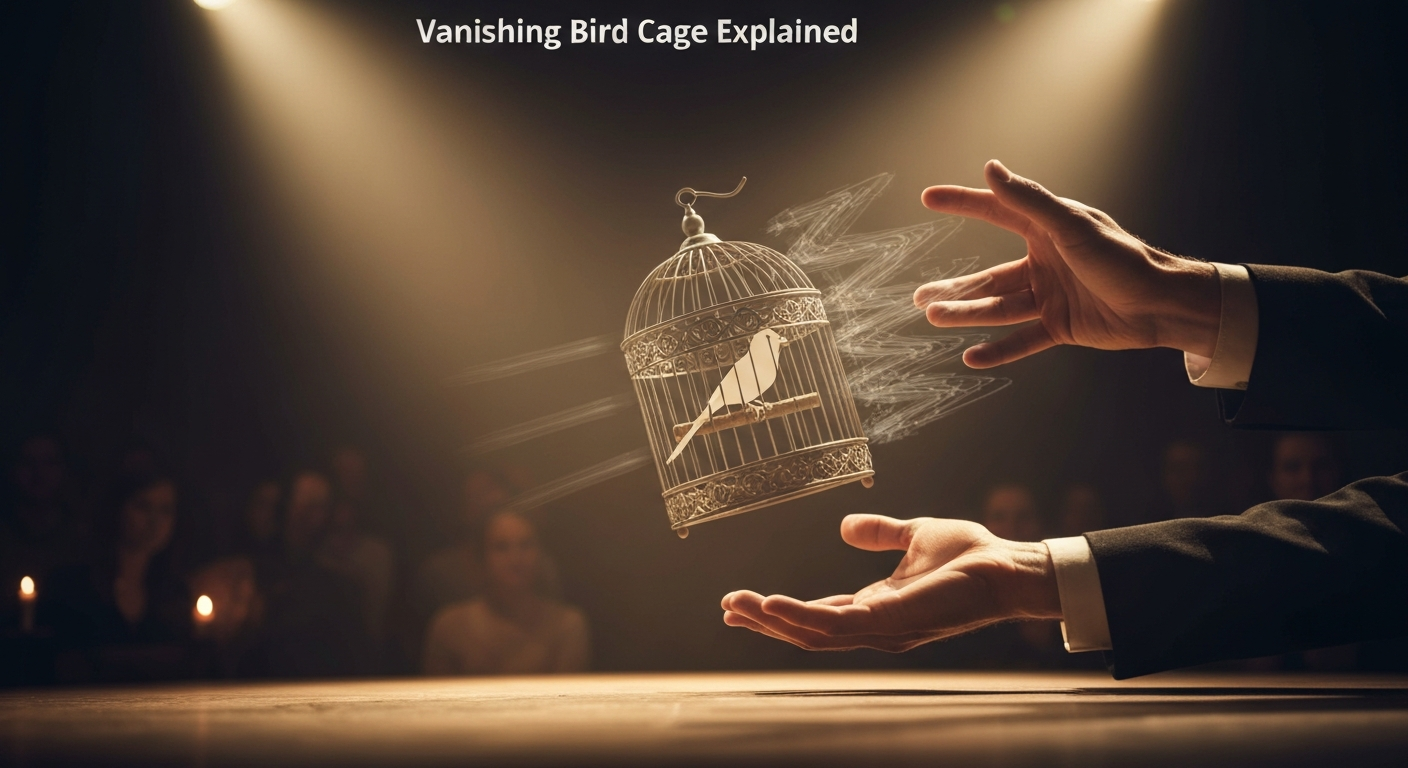
A vanishing bird cage is a classic stage illusion in which a small cage, often appearing to hold a live bird, disappears instantly from a performer's hands in full view of the audience. It has nothing to do with setting up or caring for a real pet bird cage, but it lands on this site for a good reason: bird owners, DIYers and curious performers all search the phrase, and the topic touches directly on bird welfare, prop construction and the physics of how cages move and collapse. This article gives you the honest, non-operational explainer you are looking for, plus the welfare facts and safe DIY alternatives that matter most if you work with birds.
Vanishing Bird Cage Explained: Ethics, Mechanics & DIY Fixes

Maya Bennett
24 Jul 2026
What does 'vanishing bird cage' actually mean?
The phrase describes a specific conjuring effect, sometimes called the Flying Cage or La Cage Volante, in which a small wire or metal cage vanishes from a magician's open hands in a fraction of a second. The effect is designed to look impossible: one moment you are holding a cage, the next your hands are empty. For anyone who lands here from a pet-care search, it helps to know upfront that the trick is a mechanical prop illusion, not anything related to setting up a habitat for a cockatiel or budgie. That said, the crossover with real bird welfare is important and we will get to it.
A brief history: de Kolta, Blackstone and the classic stage treatments
The vanishing bird cage was invented by French magician Buatier de Kolta, who first performed it on May 1, 1875 at the Egyptian Hall in London. Contemporary magic historians and monographs including work by Jim Steinmeyer and Mike Caveney place the effect firmly in the 1870s to 1880s parlour and variety theatre context. The compendium 500 Years of Magic History / museum references (Steinmeyer & Caveney compendium) compiles museum and archive provenance, maker labels, dated photographs and catalog entries, that support dating of the vanishing bird cage to the 1870s–1880s. De Kolta's original design used a round or cylindrical cage, and his 'Vanishing Bird and Cage' became the prototype for every subsequent version of the effect.
Over the following decades the illusion was refined, copied and credited to several makers and performers. Auction and museum catalogs, including those from Potter and Potter and collections associated with Ricky Jay, document surviving historic examples attributed to makers such as Lindhorst, Abbott's, Jay Palmer, Janos Bartl, Thayer and Martin/Al Baker. Each variation differed in size, wire gauge, semi-rigidity and perch arrangement, all of which are visible differences recorded in collector notes without revealing how any of them work.
Harry Blackstone Sr. and later Harry Blackstone Jr. made the effect one of their signature pieces in 20th-century theatre and television. The Blackstone presentation is particularly well documented because it invited children from the audience to place their hands around the cage immediately before it vanished, making the effect feel visually undeniable. Official Blackstone history and museum sources confirm this 'repeatable vanish' format as a defining feature of how the Blackstone family performed it for decades. Blackstone Magic, Harry Blackstone Sr. (official site) documents the Blackstone family's repeatable 'vanishing birdcage' presentation and its use of inviting children to place hands around the cage before it vanished blank" rel="noopener noreferrer">Blackstone Magic — Harry Blackstone Sr. (official site). The mechanics of the Blackstone version are a popular search topic on their own and relate directly to questions about how the cage behaves in slow-motion footage. If you searched for “Blackstone vanishing bird cage how does it work,” see the overview above of the Blackstone presentation and the high-level mechanics that are safe to discuss publicly.
Why this topic belongs on a bird-care site
If you are a bird owner or a DIYer who builds and customizes cages, the vanishing bird cage is relevant to you in a few practical ways. First, the prop itself is a real, physical cage with wire, frame and collapsing elements, and understanding why certain cage structures flex, compress or collapse is directly connected to the structural safety checks you should be doing on your pet's actual habitat. Second, the illusion has historically been performed with live birds, and that creates a welfare and legal issue that every bird keeper should know about. Third, if you are a performer, decorator or prop builder, there is a completely safe and ethical way to build a display-quality collapsible or dummy cage without involving any animal.
The mechanics and optics, explained at a high level
Without going into any operational detail that would reveal protected performer methods (the International Brotherhood of Magicians and the Society of American Magicians both formally oppose willful public disclosure of working methods), it is worth understanding the physical and optical principles that make a rapid vanish possible. These are the same physics concepts that apply to any fast-moving cage structure, whether it is a prop or a real enclosure that a bird pushes against.
- Semi-rigid structures: A cage made from thin wire with hinged or flexible joints can change shape dramatically in a very short time interval. The key variable is the spring or elastic constant of the wire and how many simultaneous degrees of freedom the frame has.
- Motion blur and temporal masking: At normal viewing speeds (roughly 24 to 60 frames per second), human visual processing integrates motion over a time window of approximately 40 to 100 milliseconds. Any event faster than that window appears as a blur rather than a sequence of discrete positions.
- Critical flicker-fusion and frame rate: Vision science documents that human temporal resolution varies across individuals and lighting conditions. At normal stage lighting and standard frame rates, very rapid transitions can be perceptually invisible even to attentive observers.
- Spatial misdirection and shadow cues: Changes in shadow timing, edge contrast and background brightness can mask the onset of motion. The eye tends to follow the most salient moving object in the scene, which performers exploit through choreography and lighting design.
- Multisensory integration: Sound cues, touch cues (relevant in the Blackstone audience-participation version) and visual attention interact. Perception research confirms that what you hear and feel influences what you believe you see, especially at the moment a rapid event occurs.
These concepts are documented in vision science and psychophysics literature, including work on multisensory interactions during motion perception. They are the same principles that explain why your own eye misses a fast-closing cage door, a bird escaping through a briefly open gap, or a structural collapse you did not anticipate. Understanding them is practically useful for real cage design, not just for analyzing magic tricks.
How to read slow-motion footage safely and responsibly
Slow-motion clips of the vanishing bird cage circulate widely online, and it is completely legitimate to watch them to satisfy curiosity about the physics. For annotated clips and a focused visual analysis, see our internal piece on vanishing bird cage slow motion which discusses observable optics without revealing performer methods. The key is approaching the footage as a visual analysis exercise rather than an attempt to extract and republish operational secrets. The Scientific Working Group on Digital Evidence (SWGDE) publishes best-practice guidelines for digital forensic video analysis that are directly applicable here, and they offer a clean framework for what to look for without crossing into 'how to replicate it' territory.
What to look for in the footage
- Frame cadence and dropped frames: Check whether the clip was captured natively at 240 fps or 1000 fps or whether a standard 30/60 fps clip has been artificially slowed with frame interpolation. Codec recompression artifacts and duplicated frames are giveaways. SWGDE frame-timing notes cover this in detail.
- Rolling-shutter artifacts: Smartphone slow-motion footage often uses a rolling shutter, which scans the sensor top to bottom rather than capturing the full frame simultaneously. A fast-moving object will appear to lean or distort. This is a camera artifact, not a feature of the cage itself.
- Motion onset and edge timing: At high frame rates, watch for the first frame in which a structural edge changes position. This tells you the true start time of the event, not the perceptual start time your eye assigns under normal viewing.
- Shadow timing: Shadows frequently change direction or disappear slightly before or after the object that casts them, depending on the lighting rig. This mismatch can look like a secondary optical effect but is simply a product of multi-source stage lighting.
- Background consistency: Look at background elements (drapes, stage floor, audience) across the key frames. Inconsistencies can indicate a cut or edit that is not obvious at normal speed.
Common misreadings and ethical boundaries
A common mistake is to assume that anything visible in a slow-motion frame is a deliberate mechanical element rather than an artifact of the recording process. Rolling shutter distortion, motion blur from finite shutter speed and codec compression all introduce visual noise that can look meaningful but is not. The SWGDE also notes that frame-timing metadata embedded in video files (ISO Base Media File Format fields) is often overwritten by re-encoding, so a clip you download from a social platform may not carry reliable timing data at all.
On the ethical side: sharing or publishing screenshots that you believe expose operational mechanics falls into the category of 'willful exposure' that professional magic societies explicitly oppose. The scholarly literature on performance ethics (including published work in the Journal of Performance Magic) frames this as a dual-use concern, directly comparable to how scientific journals manage research results that could enable harm if published in full operational detail. You can analyze, discuss and write about the optics and physics freely. Publishing a step-by-step breakdown of how to replicate the effect is a different matter entirely.
Observed variations and what performers have said publicly
Several publicly documented variations exist, and performers have commented on them in interviews, memoirs and television appearances without disclosing working details. The main differences visible to an observer are size, presentation context and whether the cage is handed to audience members before the vanish.
| Variation | Associated performers/makers | Visible differences | Performance context |
|---|---|---|---|
| Original cylindrical cage | Buatier de Kolta (1875) | Round/cylindrical form, relatively small, used close to body | Variety theatre, Egyptian Hall |
| Lindhorst-style semi-rigid cage | Various 19th/early 20th century performers | Semi-rigid wire, slightly larger, wire gauge visible in photos | Parlour and stage shows |
| Abbott's ribbon-trimmed brass cage | Abbott's Magic, various | Decorative ribbon trim, brass wire, compact rectangular form | Children's shows, close-up magic |
| Blackstone audience-participation version | Harry Blackstone Sr. and Jr. | Children's hands placed around cage before vanish, repeated multiple times per show | Large theatre, TV specials |
| Close-up rectangular cage | Various modern performers | Very small, fits in one hand, used at table level | Close-up and parlour magic, corporate events |
Auction catalog entries from Potter and Potter and provenance notes from the Ricky Jay collection confirm that surviving examples carry maker labels and dated photographs that allow historians to track the construction lineage. None of this information tells you how any specific version works, but it does confirm that the mechanics varied meaningfully between eras and makers, which is why slow-motion footage of one version does not necessarily generalize to another.
Why live birds must never be used in demonstrations
This is the section that matters most to this site. Historically, small birds, most often canaries, were used in performances of this effect. That practice is now unacceptable on welfare, legal and ethical grounds, and I want to be direct about why.
The physiology and stress response
Small passerine birds (canaries, finches, sparrows) and common pet species such as budgerigars and cockatiels have extremely fast metabolisms and highly sensitive stress responses. A rapid mechanical event, sudden darkness, confinement in a collapsing structure or unexpected handling by an unfamiliar person can trigger acute stress responses that include elevated corticosterone levels, rapid heart rate, feather-fluffing, open-mouth breathing and, in severe cases, sudden death from capture myopathy or cardiac arrest. These are not hypothetical risks. Avian veterinarians document stress-induced mortality in small birds that are handled or frightened even briefly.
Species-specific stress signs to know
- Canaries: sudden stillness followed by fluffed feathers, loss of song, labored breathing, falling from perch
- Budgerigars: rapid wing-fanning, open beak, tail-bobbing, loss of coordination
- Cockatiels: hissing, biting at confined space, loss of balance, repeated head-shaking
- Finches: frantic flight in confined space, head trauma from impact with cage walls, sudden collapse
- All small birds: pale or bluish coloration around the beak (cyanosis) indicates oxygen deprivation and is an emergency
Legal and regulatory issues
In most jurisdictions, using a live bird as a prop in a stage trick that involves rapid confinement, disorientation or concealment constitutes a violation of animal welfare legislation. In the United States, the Animal Welfare Act and state anti-cruelty statutes apply. In the United Kingdom, the Animal Welfare Act 2006 requires that the five welfare needs of any animal under human control be met at all times, including the need to behave normally and the need to be protected from pain, suffering, injury and disease. Many European countries have similarly broad provisions. Beyond legislation, venues and insurance carriers increasingly refuse to permit live animal acts without veterinary oversight and formal welfare plans.
The historical use of live birds in this illusion is a documented welfare problem, not a tradition worth preserving. No legitimate modern performer needs a live bird to execute this effect convincingly, and several published performer accounts confirm that professional magicians abandoned live animals in this context decades ago.
Safe and ethical alternatives for performers and prop builders
If you are a performer, prop maker or decorator who wants to create the visual of a bird-in-a-cage without any animal involvement, you have several excellent options. I have worked through most of these on the DIY side and can tell you what actually looks convincing and what falls flat.
Animatronic and realistic dummy birds
High-quality animatronic birds are available from theatrical supply companies and taxidermy suppliers. A well-made animatronic canary or budgie on a perch inside a small wire cage is indistinguishable from a live bird at stage distance. The bird can be pre-programmed to move its head or ruffle its feathers before the cage vanishes, adding to the illusion without any welfare concern. For close-up work, hand-painted resin or feather-finished dummy birds on spring-loaded perches work well and cost far less.
Camera and lighting effects for recorded or streamed performances
For video-based performances, you have access to practical lighting rigs and camera angles that make a collapsible empty cage look occupied. A small battery-powered LED warm-white light inside the cage creates a convincing illusion of a bird's warm coloring at the right exposure. Green-screen compositing with stock footage of a perched bird (using royalty-free or public-domain sources such as the Prelinger Archives or the Library of Congress National Screening Room) is another clean option that requires no animal involvement at all.
DIY display-safe collapsible cage props: a basic build guide
If you want to build your own prop cage for display, photography or stage use, here is a practical starting point. This is not a functional vanishing cage with working mechanics; it is a display-quality collapsible prop that looks great in photos and on stage.
- Choose a wire gauge of 20 to 22 AWG stainless or brass wire. This is stiff enough to hold its shape when displayed but flexible enough to compress without kinking. Avoid galvanized wire if you plan any animal-adjacent use, as zinc coating is toxic to birds.
- Build or source a simple rectangular frame from 1/8-inch brass or aluminum rod. Dimensions of 15 cm wide by 10 cm deep by 20 cm tall work well for a display canary cage. Solder or crimp the frame joints rather than using glue for durability.
- Attach wire mesh panels to the frame using small brass jump rings or wire-wrapped loops at each intersection point. Leave the bottom panel detachable for easy cleaning and storage.
- Mount a small wooden dowel perch (6 mm diameter, untreated hardwood) horizontally across the inside of the cage at roughly 40 percent of the cage height. This is where your dummy bird will sit.
- Finish the cage with a coat of clear lacquer if using brass wire, or leave stainless as-is. Add a decorative ribbon or bead trim to the top ring if you want a period-accurate look matching the Abbott's style documented in collector catalogs.
- Place your animatronic or hand-painted dummy bird on the perch and secure it lightly with a small piece of museum putty or a thin wire foot-clamp. The bird should look perched naturally but be removable without tools.
- Photo tip: shoot the finished cage against a dark background with a single warm light source to the upper right. This replicates classic stage lighting and makes the cage wires read clearly without glare.
Tool and materials checklist
- 20 or 22 AWG stainless or brass wire (at least 5 meters for a single small cage)
- 1/8-inch brass or aluminum rod (approximately 1 meter)
- Wire cutters and round-nose pliers
- Small brass jump rings (50 to 100 count)
- 6 mm untreated hardwood dowel (30 cm is more than enough)
- Clear lacquer spray or beeswax finish
- Decorative ribbon or brass beads (optional, for period finish)
- Museum putty or thin wire foot-clamp for dummy bird mounting
- Ruler, marking pen and small bench vise
Troubleshooting real pet bird cages: the practical overlap
A lot of readers who find this page are actually searching for help with a real cage problem: structural failure, an escape route they cannot locate, pest entry points, a cover that keeps slipping or a mess-control issue. If you were searching for 'to cage a wild bird how many books', see our related guide on legal and ethical considerations and recommended reading. These are legitimate pet-care problems and they deserve a direct answer.
Structural failure and unexpected collapse
If your bird's cage is collapsing, sagging or has joints that are giving way, the most common causes are corroded wire welds, loose or missing cage-clip fasteners, and bottom-tray warping that destabilizes the frame. Check every horizontal-to-vertical wire intersection for rust or weld failure. Replace any clip fasteners that spin freely rather than locking. If the bottom tray is plastic and has bowed outward, replace it with a tray cut from 3 mm HDPE sheet, which holds its shape far better under the weight of substrate and droppings.
Escape routes
Birds are better at finding gaps than you expect. Run your fingers slowly along every seam and door edge while the cage is empty. Any gap wider than the bird's skull (roughly 9 mm for a budgie, 12 mm for a cockatiel, 15 mm for a small conure) is a potential escape route. Check door latch alignment monthly because repeated opening and closing bends the latch tongue slightly over time. A small carabiner clip through the door latch is the simplest reliable secondary lock.
Pest entry points
Mites and small insects enter through gaps in the bottom tray, through seed and substrate bags brought into the house, and through unsealed seams where the tray meets the cage base. Wash the tray weekly with diluted dish soap and rinse thoroughly. Inspect the cage interior with a flashlight at night, because red mites are nocturnal and invisible during the day. Seal any gap between the tray and base frame with food-safe silicone if you find recurring entry points.
Covers and mess control
A cage cover that slips off during the night stresses birds because sudden light changes disrupt their sleep cycle. Use a cover with a drawstring or elastic hem rather than a simple drape. For mess control, fit a seed skirt (also called a seed catcher) around the lower third of the cage. These attach with small clips or hook-and-loop tape and catch the majority of thrown seed and feather debris before it reaches the floor. Cut the skirt from a medium-weight canvas or non-fraying nylon ripstop and hem the edges to prevent loose threads that could catch a toe.
Quick-reference troubleshooting checklist
| Problem | First check | Fix | Prevention |
|---|---|---|---|
| Cage sagging or collapsing | Weld integrity at wire intersections | Replace corroded sections, re-clip all fasteners | Monthly inspection, dry environment |
| Bird escaping | All door gaps, latch alignment | Carabiner clip on door latch, patch gaps with same-gauge wire | Monthly gap check with fingertip test |
| Mite infestation | Bottom tray seams, substrate freshness | Full disinfect, replace substrate, treat bird per vet advice | Weekly tray wash, buy substrate from sealed bags only |
| Cover slipping at night | Hem fit and attachment method | Switch to drawstring or elastic-hem cover | Measure cage before buying a cover |
| Excessive seed mess | Feeder placement and cage bar spacing | Fit seed skirt around lower cage | Use a hooded feeder and position it above a tray |
The bigger picture: cage design, physics and bird welfare
Whether you came here for the magic history, the slow-motion physics or a real cage problem, the thread connecting all of it is that cage design has real consequences. A frame that flexes too easily becomes an escape route. A structure that collapses in a fraction of a second can injure or kill a small bird. The same mechanical and optical principles that make a vanishing cage illusion possible are exactly the ones that make structural integrity checks important in a pet habitat. Understanding the physics at a high level, as laid out here, makes you a better cage builder and a more careful bird keeper. For a focused discussion of bird cage problem physics, see the bird cage problem physics guide on this site. It also, I hope, makes the ethics of using live animals as props completely obvious: the answer is simply not to do it, because there is no version of a rapidly collapsing mechanical cage that is safe for a small bird, and there are excellent alternatives that work just as well.
FAQ
What primary historical sources should be consulted to write an accurate history of the vanishing bird cage?
Contemporary 19th‑century press notices, playbills and theatre records for Buatier de Kolta’s 1875 Egyptian Hall premiere; maker/prop provenance in auction and museum catalogs (Potter & Potter, Rüdiger Deutsch, Ricky Jay listings) documenting surviving cages and maker names; magician memoirs/tour programs (Kellar, early Blackstone accounts); and digitized archival footage and stills from public collections (Library of Congress National Screening Room, Internet Archive/Prelinger). Use these as dated primary evidence and cite catalog entries or scans rather than procedural descriptions.
Which secondary and scholarly sources are essential for authoritative context and citation?
Magic‑history monographs and compendia (e.g., Jim Steinmeyer, Mike Caveney, '500 Years of Magic History'); peer‑reviewed or university‑press histories of stage magic that place the effect in 1870s–1880s parlour/variety context; reputable collector/curator research (museum labels, exhibition catalogs, auction catalogs). These provide synthesis, citations to primary materials, and provenance chains without operational detail.
What provenance and object‑level evidence is useful for a non‑operational mechanical description?
Detailed maker listings and item descriptions from auction/museum catalogs (surviving vanishing cages, maker attributions such as Lindhorst, Abbott, Janos Bartl, Jay Palmer), high‑resolution object photos, measurements and catalog notes that document size, materials, semi‑rigidity and perch arrangements. Use these to describe functional differences (shape, scale, materials) at a high level rather than stepwise mechanics.
What expert inputs should be sought (people to interview or consult)?
Magic historians/curators (museum of magic curators, authors like Steinmeyer/Caveney), responsible practitioner representatives (IBM/SAM officers or ethics committee members) for professional norms, conservators or prop restorers for materials/construction context, forensic video analysts or SWGDE‑affiliated experts for high‑level slow‑motion analysis guidance, vision scientists or perception researchers for explaining temporal/optical effects, and avian veterinarians/animal welfare scientists for species‑appropriate welfare guidance and policy.
Which technical/optics and video‑analysis references are necessary for non‑operational slow‑motion guidance?
SWGDE best practices and frame‑timing documentation (digital forensic video analysis, frame cadence, shutter/rolling shutter artifacts) to explain what to observe in footage; vision/perception literature (NCBI Bookshelf chapters and reviews on motion perception, temporal integration and critical flicker fusion) to explain why different frame rates reveal or mask motion; and general digital media technical notes on codecs/frame‑duplication to warn readers about artifacts that can mislead analysis.
What safety, ethics and publication‑policy sources are required to justify non‑operational treatment and withhold procedural details?
Statements and research on magician community norms and exposure ethics (IBM/SAM positions summarized in scholarly treatments like 'Toward a Theory of Exposure'); dual‑use guidance and editorial policies (NSABB/NCBI on DURC, journal policies) to justify omission of operational steps and to frame the explainer as high‑level and welfare‑focused.