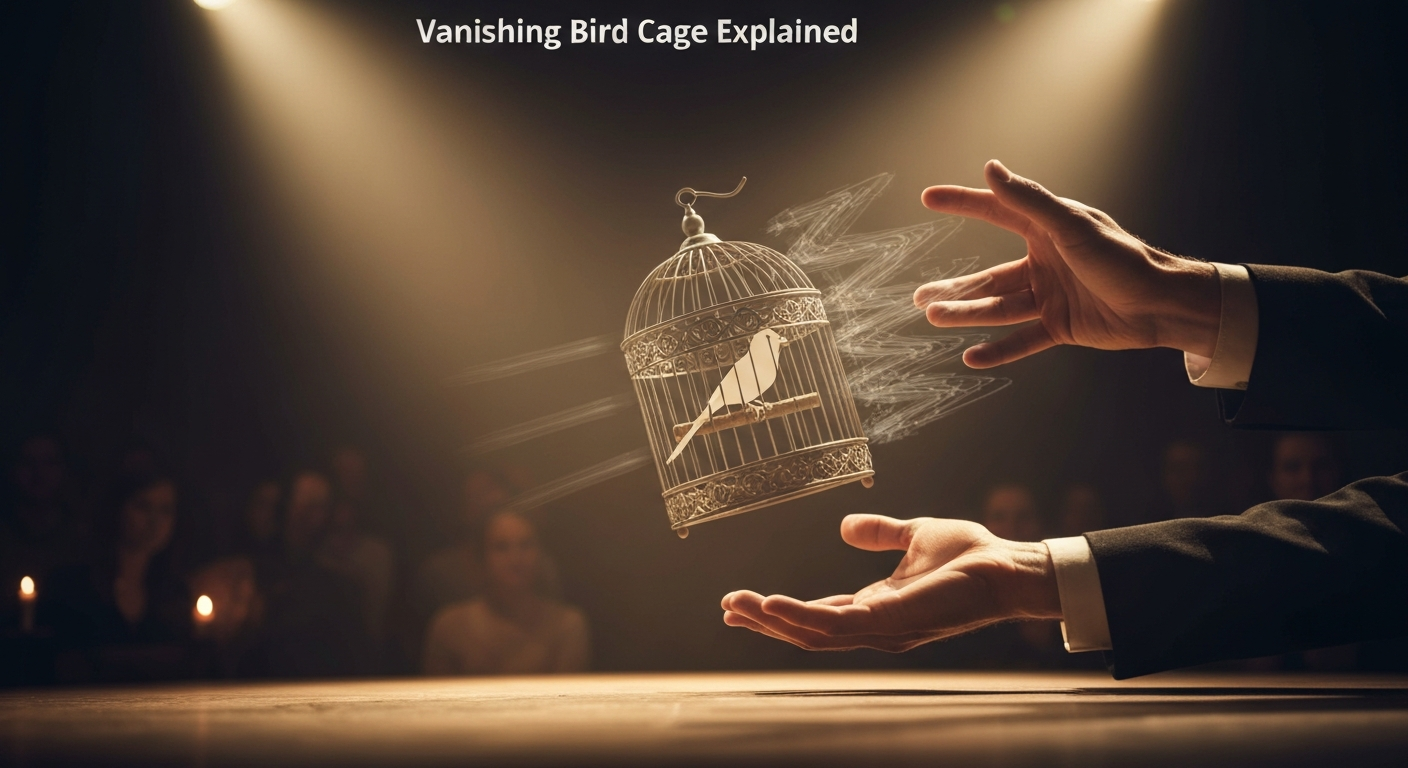
The Blackstone vanishing bird cage works by using a collapsible wire frame built around inward-folding scissor or pantograph linkages, held open by spring tension and released instantly by a concealed trigger. When the performer fires the mechanism, the cage snaps flat in a fraction of a second, the volume disappears inside a sleeve or behind the body, and the audience's eye never catches the geometry change because it happens faster than conscious visual processing. No genuine disappearance occurs, it's precision engineering timed against human perception.
Blackstone vanishing bird cage how does it work, safe guide

Maya Bennett
4 Aug 2026
What you'll learn from this article
This guide walks through the Blackstone vanishing bird cage illusion from every useful angle: its history and who performed it, a plain-language breakdown of the mechanism, a slow-motion step-by-step collapse sequence, the physics behind the snap, and, critically for anyone on this site, why live birds make the whole equation far more complicated and stressful than any highlight reel suggests. I'll also cover what a safe, bird-friendly collapsible cage actually looks like when you build one for real husbandry purposes, with material choices, tool lists and welfare checks baked in from the start.
What the Blackstone vanishing bird cage actually is
The vanishing bird cage is a stage magic prop: a small wire cage, typically sized to hold one or two small birds like a canary or budgerigar, that appears solid and rigid one moment and then simply ceases to exist in the performer's hands. The audience sees a cage, then nothing. The bird is gone. The cage is gone. It's one of the most visually clean effects in close-up and stage magic, which is why it has stayed in circulation for well over a century.
The key word is 'appears.' The cage is engineered to collapse from a rigid 3D rectangular form into a nearly flat profile thin enough to conceal along a forearm, tuck inside a jacket, or disappear into a specially made sleeve. The bird is either not in the cage at the moment of collapse (having been switched out during a preceding sequence) or, in some historically documented performances, was present during the vanish, a practice that is now widely condemned on welfare grounds and, in many jurisdictions, restricted or prohibited under animal cruelty and performance licensing laws.
A brief history: Blackstone, the makers and the lineage
The vanishing bird cage as a recognized effect dates to the mid-to-late 1800s, but it became a signature piece in 20th-century stage magic largely because of Harry Blackstone Sr. and later his son Harry Blackstone Jr. Both performed versions of the effect with remarkable showmanship, and Blackstone Jr.'s television appearances (including his well-documented performances on The Magic Palace) gave the trick its widest modern audience. Period magic journals including The Sphinx covered it extensively, and a documented lineage of propmakers, including John Martin, Will Lindhorst, Pete Bouton and the Milson Worth/Abbott Magic catalog variants, produced the physical props these performers used.
Other notable performers associated with the effect include John Mulholland, Kenneth de Courcy (whose 1937 performance survives in British Pathé newsreel footage), and Billy McComb, who was known for a deliberate 'slow-motion' presentation style that showed off the illusion's timing rather than relying purely on speed. Tommy Wonder also studied and analyzed the effect in depth, and his approach to the mechanics and performance rhythm is still discussed in magic circles. The fact that multiple independent propmakers produced competing designs, each with slightly different linkage and take-up methods, tells you something important: there is no single 'secret.' The effect is a family of engineering solutions converging on the same visual result.
How the trick works: a plain-language overview
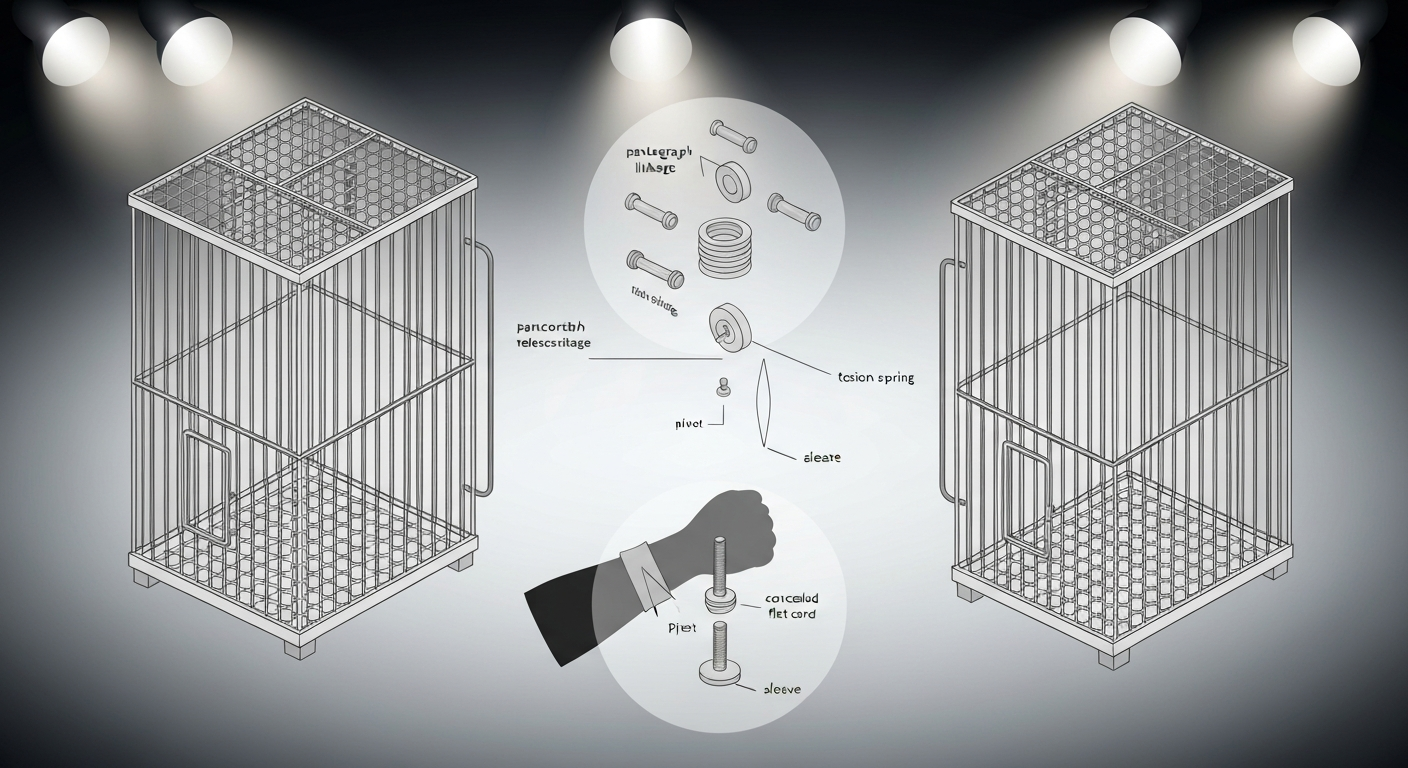
The cage is built from a lightweight metal frame, typically a fine-gauge wire mesh or rod skeleton, where every structural member is connected through hinges or pivot joints rather than rigid welds. The frame is normally held in its open, rigid shape by spring preload: the springs store energy and push the linkages into the locked-open position. When a concealed release (a trigger, a pull cord, a deliberate grip change) is activated, the stored spring energy reverses direction, pulling all the frame members inward simultaneously. The cage inverts or folds flat against itself, reducing its projected volume by 90 percent or more in under a second.
Concealment happens in the same motion. The performer's arms, jacket, body position and audience misdirection are all choreographed so that the collapsed flat form disappears into a sleeve, a jacket panel, or simply behind the natural silhouette of the body as it rotates. Because the human visual system relies on tracking edges and contours, and the collapse removes all those edges almost instantaneously, the brain registers 'gone' rather than 'folded.' The related slow-motion breakdown below makes this sequence easier to follow frame by frame.
The mechanical components, taken apart
If you wanted to reverse-engineer a vanishing cage from first principles, you would be working with six functional subsystems. Understanding each one is also directly useful if you're thinking about building any kind of collapsible, portable cage for actual bird housing, because the engineering challenges overlap more than you'd expect.
The frame and wire mesh
Commercial magic cages use very light-gauge steel or aluminum wire, silver-plated for visibility under stage lighting. The mesh panels between structural ribs are usually formed from the same wire bent into a grid, not welded at every crossing, so they flex without breaking when the frame collapses. Frame dimensions in classic designs typically sit around 6 to 8 inches long, 4 to 5 inches wide, and 4 to 5 inches tall in their open position, large enough to look convincing with a small bird inside, small enough to palm or sleeve when flat.
Hinges and pivot joints
Each corner and each mid-span structural member terminates in a hinge or pivot. In pantograph/scissor-linkage variants, pairs of crossing struts pivot at their midpoint, so when one end of each strut is pulled inward, the opposite end follows in a coordinated motion, the same geometry used in Hoberman spheres and deployable space structures. In simpler 'umbrella rib' designs, the vertical corner posts are hinged at the top and bottom so the walls fold inward like a collapsing lantern. Some commercial designs combine both approaches, using crossing struts for the long walls and folding ribs for the short ends.
Springs and stored energy
The snap speed that makes the trick so effective comes almost entirely from spring preload. Torsion springs at hinge points or tension springs along the diagonal members store enough energy to drive the collapse in 50 to 150 milliseconds, well below the 200-millisecond threshold of human saccadic eye movement. The spring tension must be carefully calibrated: too light and the cage collapses sluggishly or incompletely; too heavy and the snap generates impact forces at the end of travel that can damage the frame, injure a bird, or pinch a performer's fingers. Engineering literature on deployable scissor structures recommends controlled energy dissipation through friction brakes or viscous dampers to prevent high-acceleration end-of-travel shocks.
The release mechanism
Releases in documented designs range from a simple grip-pressure trigger (squeezing the cage bottom actuates a latch) to a pull cord running up the sleeve to a take-up reel concealed on the body. The take-up reel version uses a retractable cord under spring tension, similar in concept to an industrial badge reel but much more powerful, that physically pulls the cage flat and retracts it simultaneously. This is why some historical descriptions of the trick mention a 'reel' or 'hookup' in performer notes: the cord is pre-attached before performance, and activating the reel does both jobs (collapsing and concealing) in one motion.
Concealment method
Once flat, the collapsed cage must go somewhere the audience cannot see it. Classic methods include a sewn sleeve channel running along the inside of a jacket or tail coat, a flat pocket at the back waistband, or simply the gap between forearm and body during a natural arm movement. The geometry of 'flat' is critical here: a cage that collapses to 10mm or less in thickness can disappear behind a forearm with no visible bulge under a rolled-up sleeve. Patents on collapsible cage designs (including US2799244A and US3029788A) document the engineering required to achieve this thin collapsed profile, with nested panels and interlocking wire elements that stack flush. See patent US2799244A, Collapsible bird cage (Google Patents) for an example of nested panels and interlocking wire elements designed to stack flush when collapsed US2799244A — Collapsible bird cage (Google Patents).
Slow-motion breakdown: the collapse sequence step by step
Frame-by-frame analysis of archival footage, including the British Pathé clip of Howard de Courcy's 1937 performance and Blackstone Jr.'s television appearances, lets you reconstruct the sequence with reasonable precision. Here is what is happening at each stage, written as a slow-motion walkthrough.
- Pre-trigger (0 ms): The cage is held in both hands, fully open, springs loaded. The audience sees a solid rectangular cage. The performer's grip is positioned so thumbs or fingers are already resting on the release points without visibly pressing them.
- Misdirection window (0 to ~300 ms): A verbal beat, a glance toward the audience, or a gesture from the non-cage hand draws eye attention away from the cage. This window does not need to be long — just enough for one saccadic eye movement away from the hands.
- Release fires (~300 ms): The latch disengages or the take-up cord pulls taut. Spring preload converts immediately to kinetic energy. The crossing struts or hinge ribs begin rotating inward simultaneously — not sequentially.
- Mid-collapse (~350–400 ms): All four walls fold inward symmetrically. Because the collapse is symmetric, there is no visible tilting or rolling of the cage body as seen from front-of-house — it simply reduces in every dimension at once. The projected silhouette shrinks, but because edges are collapsing rather than translating, the visual system struggles to register the change as motion.
- Full flat (~400–450 ms): The cage reaches its fully collapsed state, typically 8–15 mm thick. End-stop contact occurs here, and if there is no damping, a small metallic click or vibration is audible. Well-made props include a felt or rubber end-stop to suppress this.
- Concealment (~450–600 ms): The collapsed flat form is drawn into the sleeve channel, tucked behind the arm, or retracted by the take-up reel. This is usually the slowest part of the sequence, but because the cage is now effectively invisible in profile, there is nothing for the eye to track.
- Final position (~600 ms onward): Hands are open and empty. The performer may spread fingers, turn palms to the audience, or continue into the next sequence. The visual 'proof' of emptiness closes the effect.
Billy McComb's 'slow-motion' performance style worked by extending the misdirection window and the pre-trigger phase, not by actually slowing the mechanical collapse. For a visual example, see a focused clip of the vanishing bird cage slow motion demonstrating the collapse timing and performer pacing. The spring-driven snap itself was just as fast, what differed was the theatrical pacing around it, which made the vanish feel considered and deliberate rather than rushed. Tommy Wonder's analytical approach to the same sequence emphasized that every millisecond of performer movement before and after the release affects how the vanish reads, because the brain uses surrounding motion context to interpret what it just saw.
The physics and engineering behind the snap
The vanishing cage is a textbook example of snap-through instability. See a focused discussion of bird cage problem physics for more on bistable snap-through dynamics and related safety implications. The frame is designed to have two stable states, fully open and fully flat, with an energy barrier between them. Pre-loading the springs stores potential energy in the barrier state. When the release fires, the system passes through the barrier and falls into the second stable state almost instantaneously, releasing all stored energy as kinetic energy of the collapsing members. This is the same mechanical principle used in snap-dome switch contacts, bistable mechanisms in deployable aerospace structures, and the Venus flytrap's leaf closure.
Angular momentum matters here. Because the struts are rotating rather than translating, angular acceleration determines how fast the tips of each strut move. A 6-inch strut rotating through 90 degrees in 150 ms has its tip moving at roughly 2.5 meters per second at peak velocity, fast enough that a misplaced finger caught in the collapse path would be hit with significant force. Peer-reviewed engineering literature on deployable scissor and pantograph structures specifically identifies end-of-travel snap loads as a key safety hazard and recommends either friction damping at pivot points or multi-stage springs (where a softer secondary spring absorbs end-stop impact) to control this.
Hinge geometry also governs whether the collapse stays symmetric or goes off-axis. In a well-built cage, all pivot points are precisely equidistant from the center of mass, so the collapsing frame does not translate laterally or rotate visibly during the snap. Any asymmetry in spring loading, hinge friction or wire weight distribution will produce a slight tilt, which is both a visual tell and a handling problem. This is why the older hand-built propmaker tradition placed such value on precise symmetry in the cage skeleton, it is not just aesthetic.
Why live birds make everything harder and more dangerous
This is the section where I need to be direct with you, because the welfare case here is not ambiguous.
Small birds, canaries, budgerigars, finches, are physiologically vulnerable to acute stress in ways that are now well documented in peer-reviewed research. Restraint studies in domesticated budgerigars show significant increases in plasma corticosterone (the avian stress hormone) even from brief handling and the presence of a human observer. Canary research using fecal corticosterone assays confirms measurable stress responses to short-term confinement and sudden motion. These are not subtle effects: the hormonal response is rapid, and repeated exposure does not produce the same kind of habituation that might blunt the response in a mammal.
Now add the specific variables of a vanishing cage performance. The bird is in a small enclosure, under bright stage lighting, in a loud and unfamiliar environment. A human is handling the cage with deliberate grip changes. Then, in under 200 milliseconds, every structural member of the enclosure accelerates inward at several meters per second. Even if the bird is not physically struck by a collapsing wire, which is not guaranteed, the sudden loss of cage geometry, the acceleration forces transmitted through the floor of the cage, and the abrupt transition to concealment inside a sleeve or jacket would each individually be a significant stress event. Combined, they represent a serious welfare risk.
There is also a direct physical injury risk. OSHA and related standards (ISO/ANSI) define pinch‑point hazards and prescribe the risk‑reduction hierarchy: eliminate/reduce by design, then guards/safeguards, and only then warnings/PPE OSHA eTool — Machine Guarding (pinch‑point identification and controls) notes pinch‑point hazards and recommends eliminating or reducing the hazard by design and using guards or safeguards before relying on warnings or PPE.. The spring forces required to produce the fast snap that makes the trick work are the same forces that can trap and injure fingers, forum reports from experienced performers document injuries to their own hands. A bird cannot anticipate the collapse, brace, or move clear. Wing, leg or toe entrapment in folding wire members during a snap-through collapse is a realistic outcome, not a remote possibility.
Beyond welfare, the legal landscape has shifted substantially. Many countries and U.S. states now require permits or explicitly prohibit the use of live birds in stage performances involving restraint or mechanical apparatus. Animal cruelty statutes increasingly cover stress-inducing handling practices, not just visible physical injury. Any performer or event organizer considering a live-bird version of this effect should consult local animal protection law before proceeding, and should expect that the answer is often 'no.'
Ethical alternatives that still deliver the effect
The good news is that the visual impact of the vanishing cage does not actually require a live bird. Skilled performers have used stuffed or replica birds, animatronic birds, projection-mapped illusions, and, most commonly, a bird that is genuinely present at the start of a sequence but switched or concealed well before the cage collapse occurs, so the 'vanish' itself involves no animal at all. The audience perceives a bird vanishing; the bird is already safe and comfortable in a covered transport box offstage. This is both the most ethical and, arguably, the most technically reliable approach, since it removes the largest unpredictable variable from the mechanical sequence entirely.
Building a safe collapsible bird cage for real-world use
If the collapsible cage concept interests you for practical husbandry reasons, a portable travel cage, a temporary enclosure for outdoor time, a hospital cage that stores flat, you can take the same engineering principles and redesign them around animal welfare from the ground up. For further reading on practical designs and husbandry considerations, see to cage a wild bird how many books for recommended guides and design references. The magic prop version optimizes for speed, thinness and concealment. Your version optimizes for bird safety, ease of cleaning, non-toxic materials and controlled, slow deployment.
Materials and tool list
- 304-grade stainless steel wire mesh (16 to 18 gauge), powder-coated or bare — no galvanized wire, which can leach zinc
- Aluminum or stainless hinge hardware (no zinc-plated or cadmium-plated fittings)
- Food-safe epoxy or stainless rivets for panel joins (no lead solder)
- PTFE-coated or stainless torsion springs rated for slow, controlled deployment (not snap-through)
- Closed-cell foam (non-toxic, bird-safe EVA foam) for edge cushioning on all folding members
- Tool list: wire cutters, round-nose pliers, rivet gun, hand drill with stainless bit set, needle-nose pliers, spring tension gauge
Key design differences from a magic prop
Where the magic version uses maximum spring preload to guarantee a fast snap, your collapsible travel cage should use minimal spring assist, just enough to hold the panels in the open position against accidental bumping, not enough to power a self-actuated collapse. Deployment and collapse should require deliberate two-handed operation, with a positive locking latch in both the open and closed positions. Edge cushioning on all hinged members is non-negotiable: EVA foam strips bonded to every fold-edge eliminate the pinch risk that is the core safety hazard of the magic prop design.
Assembly sequence
- Cut mesh panels to size and file all cut edges smooth — run a gloved finger along every edge before assembly to check for wire burrs that could injure feet or feathers.
- Attach hinge hardware to panel edges using stainless rivets, not adhesive alone. Test each hinge through its full range of motion before connecting to adjacent panels.
- Install torsion springs at corner hinges, pre-loaded to hold panels at 90 degrees open but easily overcome by hand pressure — test this with a spring tension gauge before housing the bird.
- Add positive-lock latches at all four top corners and the door frame. Test each latch for positive engagement — it should not release under a 2 kg pull force.
- Bond EVA foam strips to all fold edges. Allow full cure time per manufacturer instructions before use.
- Install a removable tray in the base using two side-channel guides so it pulls out for cleaning without disturbing the cage structure.
- Test the full fold-and-lock cycle ten times without the bird present, checking for any binding, sharp protrusions, or spring behavior that feels inconsistent.
Placement, seasonal protection and mess control
A collapsible cage used outdoors for supervised flight time should never be placed in direct afternoon sun without a partial shade cover, a clipped-on UV-filtering mesh panel works well and folds with the cage. In cold weather below 10°C (50°F), small birds should not be in an uninsulated outdoor enclosure at all, collapsible or otherwise. For indoor use, keep the cage away from kitchen fumes, PTFE-coated cookware vapors and drafts from air conditioning vents, all of which are disproportionately hazardous to small birds compared to mammals.
Mess control with a collapsible design is actually easier than with a fixed cage if you plan the base tray well. A tray with 2-inch side lips retains most seed hulls and droppings. Line it with unbleached paper that you roll and discard rather than scrub. For pest prevention, the flat-fold storage position is an advantage: fold and store the cage in a sealed bag or box between uses to prevent mite colonization in wire joints, which is a common problem with fixed cages stored in garages or sheds.
Troubleshooting common problems
| Problem | Likely cause | Fix |
|---|---|---|
| Cage won't stay fully open | Spring tension too low or latch not engaging properly | Recheck latch engagement; replace springs if tension gauge reads below spec |
| Panels bind during fold | Hinge misalignment or burr on pivot point | Disassemble, file pivot pin smooth, realign hinge plate and re-rivet |
| Wire mesh developing rust spots | Non-stainless grade or coating damage from cleaning chemicals | Replace with 304 stainless; use only mild soap and water for cleaning |
| Bird avoiding the cage | New material smell or unfamiliar structure | Air cage outdoors for 24–48 hours; place familiar perch and food inside before introducing bird |
| Base tray warping | Tray material too thin or exposed to moisture | Use 1.5 mm aluminum sheet for tray; dry thoroughly before folding for storage |
The bigger picture: illusion engineering meets bird welfare
The Blackstone vanishing bird cage is a genuinely impressive piece of engineering. The snap-through bistable mechanism, the symmetric pantograph kinematics, the take-up concealment system, these are all elegant solutions to a hard physical problem, and studying them gives you real insight into deployable structure design. But the same forces that make the trick so visually clean are the forces that make it physically dangerous for a live bird: high angular accelerations, unpredictable stress responses in small avians, and pinch-point risks that even experienced human performers have documented getting caught in. For a concise technical summary, see vanishing bird cage explained.
The practical takeaway for anyone coming to this from a bird-owner or cage-builder perspective is this: the collapsible cage concept is genuinely useful for portable and travel applications, but it needs to be redesigned from the ground up with welfare as the primary constraint rather than an afterthought. Slow, deliberate deployment, positive locking in both states, cushioned fold edges and bird-safe materials get you the convenience of the flat-fold format without any of the risk. That is a project worth building.
FAQ
What primary historical and documentary sources should I consult to accurately describe the vanishing birdcage’s provenance and variants?
Collect period magician journals (The Sphinx), MagicPedia/Genii articles, dedicated vanishing‑birdcage blogs, and performer archives (Blackstone Sr./Jr., Howard de Courcy, Mulholland). Use these to date variants, credit makers (Lindhorst, Martin, Bouton, McComb) and distinguish performance styles (flash vs slow‑motion). Cite clips and contemporaneous writeups for performance context rather than construction plans.
Which patent and technical documents are essential for a factual mechanical description and safe DIY design ideas?
Locate relevant patents (e.g., US2799244A, US3029788A and international equivalents like CN201905128U) that describe collapsible/telescoping cage architectures. Use them to extract linkage families (nested shells, sliding guides, hub/linkage assemblies) and as legal references for public domain/expired designs. Annotate which elements are patented vs commonly used mechanical principles.
What kinds of motion analysis sources allow a slow‑motion mechanical breakdown of the trick?
Gather high‑frame‑rate or archival video (British Pathé, TV studio clips of Blackstone Jr., performer tutorials) to analyze timing and visible linkage motion. Supplement with magician teaching DVDs/recordings that discuss cadence and ‘take‑up’ methods. Use frame‑by‑frame review to identify visible hooks, reels, sleeve actions and collapse sequence without revealing protected construction secrets.
What engineering literature should I review to explain the kinematics, dynamics and safe collapse control principles?
Use engineering papers on pantograph/scissor linkages, deployable structures, and mass‑balance (e.g., spatial pantograph research, computational design of bistable scissor structures). Extract concepts: center‑of‑mass behavior, snap‑through risks, required damping/braking, staged energy release, and how to specify dampers or friction brakes to control collapse speed for safety.
Which safety standards and risk‑assessment frameworks are required to assess pinch‑point and animal‑welfare hazards?
Reference OSHA pinch‑point guidance and ISO 12100 (risk assessment and reduction). Cite relevant guarding/ protective device standards (ISO 14120 / EN ISO 14120) as high‑level frameworks. Apply the hierarchy of controls (eliminate hazard by design, guards, administrative controls, PPE) when designing moving props that could contact birds or handlers.
What avian welfare and veterinary science sources must inform any guidance about using live birds?
Use peer‑reviewed studies on avian stress (corticosterone responses to handling/restraint in budgerigars and canaries), reviews on transport/confinement risks, and veterinary guidance on handling and humane treatment. Include non‑invasive monitoring methods (fecal corticosterone) and clinical risk factors (shock, trauma, chronic stress) to justify prohibitions and mitigation measures.
Next Article
Vanishing Bird Cage Explained: Ethics, Mechanics & DIY Fixes
Vanishing bird cage explained: ethical history, safe DIY props, welfare tips and real‑cage troubleshooting.