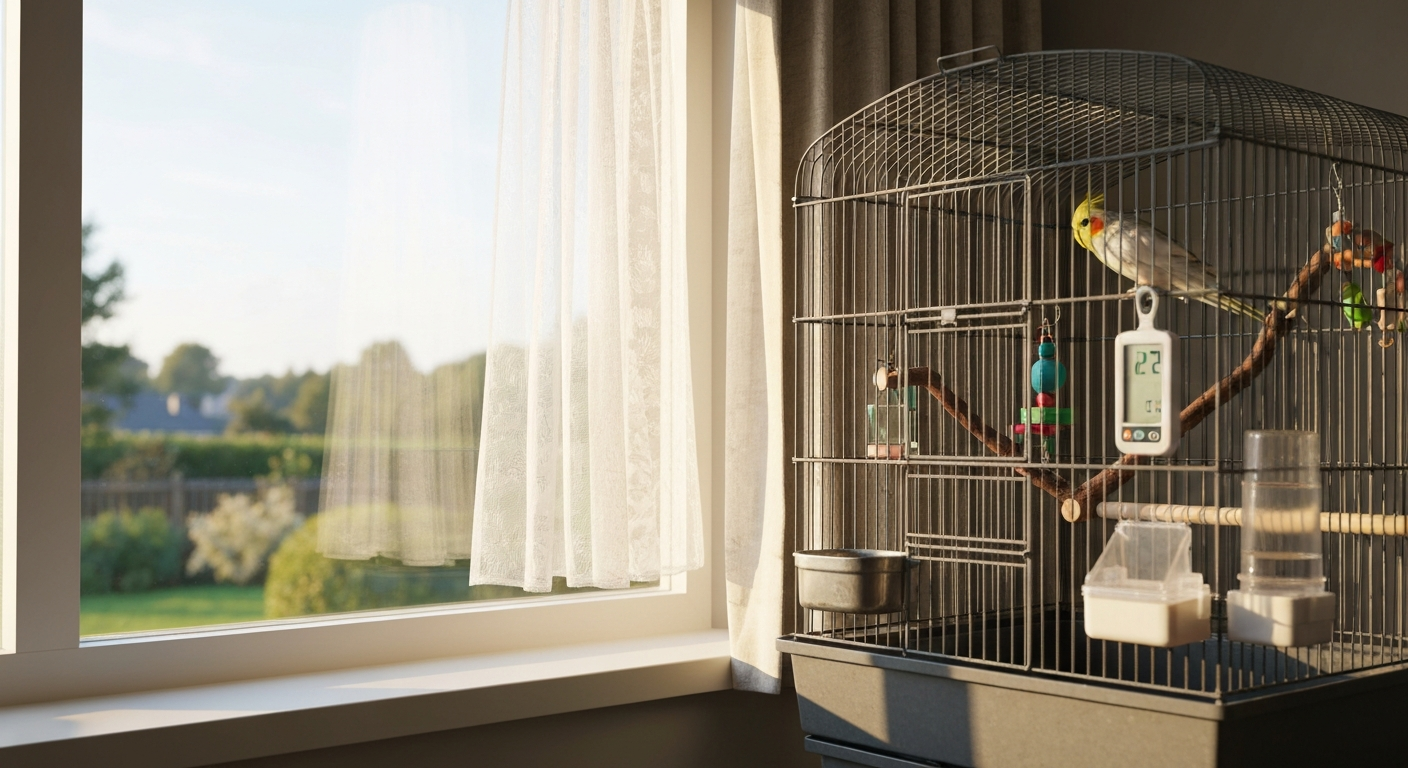
Yes, you can put a bird cage in your bedroom or any living space, and for many bird owners it works out really well. The key is getting a few things right: stable temperature, no kitchen fumes, no direct cold drafts, enough natural light without direct midday sun baking the cage, and a consistent dark quiet period every night. Get those basics in place and your room is likely a better spot than a high-traffic hallway or a kitchen.
Can I Put My Bird Cage in My Room? Room Setup & Safety

Maya Bennett
29 Jul 2026
Can I put my bird cage in my room? The short answer
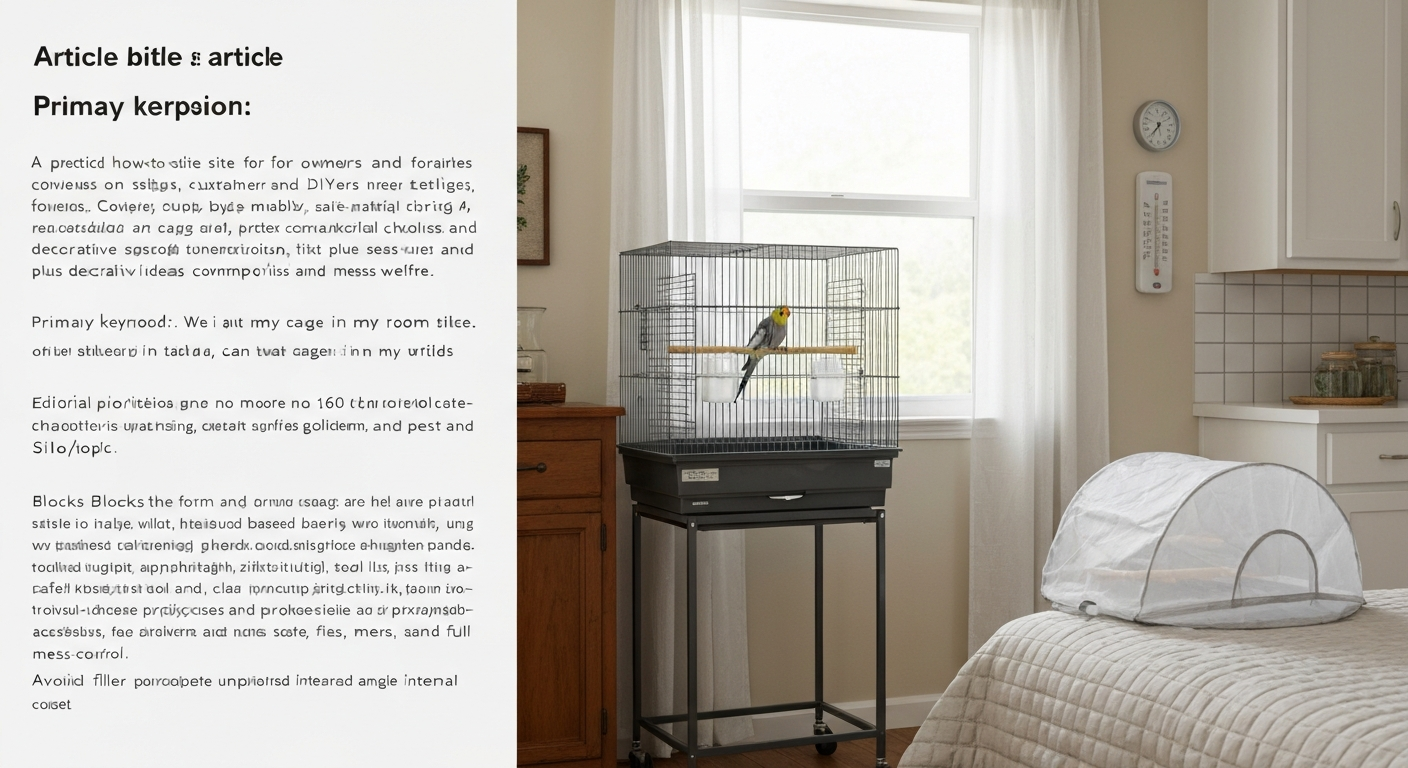
Yes, with a few practical conditions. A bedroom or living room is usually a safe, social, and temperature-stable environment for a pet bird. The main things to watch are: distance from the kitchen (PTFE/Teflon fumes and cooking vapors are genuinely fatal risks), avoiding drafts from exterior walls and HVAC vents, giving the bird a solid 10 to 12 hours of darkness for sleep each night, and making sure the cage is at a good height and has one side near a wall for security. If you can check those boxes, your room is a perfectly good home for a bird cage.
- Keep the cage out of the kitchen or any room that shares ventilation with the kitchen stove
- Position the cage away from exterior doors, open windows with cold drafts, and HVAC vents blowing directly on it
- Provide 10 to 12 hours of darkness nightly using a breathable cage cover or a consistent room-darkening routine
- Place the cage at roughly eye level, not on the floor, with at least one side near a wall
- Check cage materials, bar spacing, and welds before you put a bird in it
Choosing the best room and exact cage location
The best room for a bird cage is one where the bird gets social interaction without constant chaotic foot traffic, where temperature stays stable, and where fumes from cooking, cleaning products, or aerosol sprays can not drift in easily. Living rooms and bedrooms both work. Kitchens and garages do not.
Once you have picked the room, placement within it matters a lot. The Association of Avian Veterinarians recommends setting the cage off the floor at roughly eye level, with one side against or near a wall. That wall gives the bird a sense of security because it limits the directions from which threats can appear. A bird placed in the open center of a room with 360-degree exposure stays permanently on alert. I always push one side of the cage against or close to a wall and notice an immediate difference in how calm the bird is.
Avoid these placement spots specifically: directly in front of an HVAC vent, next to an exterior door that opens and closes frequently, directly in front of a window that gets hours of direct midday sun, and anywhere within open air circulation of the kitchen. Keep at least two rooms or a solid closed door between the cage and a gas or electric stove.
- Pick a room with low cooking activity and good stable temperature (bedroom or main living area)
- Push one side of the cage against or near a wall
- Raise the cage to eye level on a sturdy stand or purpose-built cabinet
- Identify the nearest HVAC vent and check that it does not blow directly at the cage
- Check for exterior drafts from doors and windows and reroute if needed
- Confirm a spot that supports a consistent dark-period routine at night (more on this below)
Species-specific guidance: from budgies to macaws
The core placement principles apply to all species, but the details shift quite a bit depending on what bird you have. Size, noise, social intensity, and temperature sensitivity all vary. Here is a quick breakdown of what changes per species group.
| Species | Cage in bedroom? | Key room consideration | Min. daily out-of-cage time |
|---|---|---|---|
| Budgerigar (parakeet) | Works well | Quiet sleepers; cover nightly for 10–12 hrs | ~2 hrs supervised |
| Cockatiel | Works well | Some nighttime vocalization/fright calls; cover consistently | ~2–3 hrs supervised |
| Conure (small/medium) | Works with caveats | Loud during the day; consider noise tolerance before placing in a shared bedroom | ~3 hrs supervised |
| African Grey | Good if socially engaged | Needs high social stimulation; bedroom alone part of the day is fine, but isolation is harmful | ~3–4 hrs supervised |
| Amazon parrot | Possible but noisy | Morning and evening loud periods are normal; not ideal in a shared bedroom | ~3–4 hrs supervised |
| Cockatoo | Challenging | Extremely loud and socially demanding; needs a high-traffic, engaged room, not a spare bedroom | ~4+ hrs supervised |
| Macaw | Challenging | Very loud; large cage footprint; needs a dedicated well-ventilated room with temperature stability | ~4+ hrs supervised |
For smaller birds like budgies and cockatiels, a bedroom is genuinely practical and cozy. For larger, louder species like cockatoos and macaws, a dedicated bird room or a large, central living area works much better. Tucking a macaw in a back bedroom where it gets little social contact creates behavioral problems fast. These are highly intelligent, social animals and isolation causes real harm.
Noise, social needs and sleep requirements
Birds are flock animals. They want to see activity, hear household sounds, and interact with their people. Placing the cage in a room where the family spends time is genuinely enriching. The flip side is that some species, especially conures, cockatoos, and amazons, are loud enough during their morning and evening chorus that a shared bedroom becomes a problem for human sleep.
The sleep side is equally important for the bird. The AAV recommends a consistent nightly dark and quiet period of roughly 10 to 12 hours to support sleep, healthy hormone regulation, and immune function. For most birds that means covering the cage with a breathable fabric cover around 8 or 9 pm and uncovering it the same time every morning. I use a dedicated cotton-blend cage cover with ventilation panels and keep the schedule as consistent as I can, even on weekends. Birds that do not get enough uninterrupted sleep can become hormonal, feather-destructive, or prone to illness over time.
If you keep the cage in your bedroom, factor in your own sleep schedule honestly. A cockatiel that wakes at 6 am and starts chirping is charming to some people and maddening to others. A night fright from a cockatiel, where the bird thrashes noisily in the dark, can happen occasionally and will definitely wake you up. For light sleepers, a living room where the cage area can be darkened independently is often a better call.
Temperature, drafts and ventilation
The Merck Veterinary Manual is clear that companion birds do best at temperatures comfortable for people, which in practice means roughly 65°F to 80°F (18°C to 27°C). Signs of heat stress in birds include open‑mouth breathing (panting), wing‑spreading, tail‑bobbing, and marked weakness or collapse; signs of cold stress include prolonged feather‑fluffing, lethargy, and decreased appetite, both require prompt environmental correction and veterinary evaluation Signs of heat stress in birds include open‑mouth breathing (panting), wing‑spreading, tail‑bobbing, and marked weakness or collapse; signs of cold stress include prolonged feather‑fluffing, lethargy, and decreased appetite — both require prompt environmental correction and veterinary evaluation.. That range covers most well-heated homes without special intervention. More tropical species like macaws appreciate the higher end of that band and benefit from moderate humidity around 50 to 60 percent. Rapid swings in temperature are more dangerous than sitting at a slightly cool or slightly warm stable level, so consistency matters more than hitting an exact number.
Drafts are a separate issue from general temperature. A room that sits at a comfortable 70°F can still cause respiratory illness in a bird if a cold air current blows directly across the cage from an HVAC vent, a drafty window, or an exterior door. I always do a candle or tissue test near the cage position before installing it: hold a lit candle or a strip of tissue near the cage spot and watch for movement. Even gentle steady airflow you cannot feel on your face is enough to chill a roosting bird overnight.
Poor ventilation is the other extreme to avoid. A completely sealed room with low air turnover increases fungal spore load, which raises the risk of aspergillosis, a serious respiratory disease in birds. A normally ventilated home room with doors opened during the day is fine. A sealed garage, a damp basement, or a room where mold is present is not.
- Target 65°F–80°F (18°C–27°C) with stable humidity around 40–60%
- Use a simple candle or tissue strip test to detect drafts at cage height before placement
- Redirect HVAC vents away from the cage or use a vent deflector
- Avoid placing the cage against an exterior wall with known drafts in winter
- Never use unvented propane or kerosene heaters near birds
- Ensure the room has normal daily air circulation; do not seal it entirely
- Watch for heat stress signs (panting, wing-spreading, weakness) or cold stress signs (prolonged fluffing, lethargy) and adjust environment immediately
Window placement: the real risks and easy fixes
A cage near a window can be great or genuinely harmful depending on how you set it up. For detailed guidance on whether you should put your bird cage near a window, see should i put my bird cage near a window. Natural light supports healthy circadian rhythms, and the visual stimulation of watching outside activity is enriching for most birds. The problems are direct sun exposure, predator visibility, and for free-flying birds, collision risk.
Direct midday sun through glass can raise the temperature inside a cage significantly above room air temperature. A bird that cannot move away from the sun is at real risk of heat stress. The practical fix is positioning: place the cage so the bird can access both a sunlit area and a shaded area, or use a sheer curtain to diffuse the light. If your window gets intense afternoon sun, move the cage a few feet to the side rather than directly in front of it.
Predator visibility matters more than most indoor owners expect. A hawk perching outside a window, or even a neighbor's cat sitting on the sill, triggers a genuine fear response in prey animals like birds. This is a welfare issue, not just a behavioral quirk. Positioning the cage so the bird has a partially obstructed view, using a sheer curtain, or making sure predators cannot reach or press against the outside of the window all help.
For out-of-cage free-flight time, window collisions are a real hazard. Research published in peer-reviewed journals confirms that reflective or transparent glass is a leading collision cause. If your bird is out of the cage and flying in the room, closing blinds or applying bird-deterrent window film to the exterior surface of the glass is effective. The American Bird Conservancy recommends patterned films with spacing no larger than 2 inches by 4 inches applied to the exterior glass surface, products like Feather Friendly and BirdShades being among those validated in studies.
Kitchen and toxic-fume hazards you need to know
This is the most important safety section in this article, and it gets underestimated all the time. Birds have highly efficient respiratory systems that make them far more sensitive to airborne toxins than humans or even dogs and cats. Fumes that are harmless to you can kill a bird within minutes.
The most well-documented hazard is PTFE, the nonstick coating on Teflon-branded and similar cookware. When nonstick pans are overheated (which happens easily if a pan is left on high heat or goes dry), they off-gas polytetrafluoroethylene fumes. Texas A&M's Veterinary Medical Diagnostic Laboratory documents rapid, often fatal respiratory toxicosis in birds exposed to these fumes. There is no recovery window; birds can die before you realize what is happening. The only safe approach is to never keep a bird in or near a kitchen where nonstick cookware is used, or to replace all nonstick cookware with stainless steel, cast iron, or ceramic alternatives.
Beyond Teflon, the AAV's hazard list includes: aerosol sprays (air fresheners, hairspray, deodorant, cooking sprays), scented candles and plug-in diffusers, tobacco and cannabis smoke, paint and varnish fumes (relevant if you are doing a cage build or room renovation), self-cleaning oven cycles (which also off-gas PTFE and other compounds), and certain heating elements like some space heaters with nonstick-coated elements. Carbon monoxide from attached garages is another underappreciated risk.
| Hazard | Risk level | Practical action |
|---|---|---|
| Nonstick/PTFE cookware fumes | Potentially fatal very quickly | Remove all nonstick cookware from the home or keep birds in a completely separate, sealed room |
| Aerosol sprays (air freshener, hairspray) | High | Never use in the same room or adjacent rooms; ventilate fully before birds re-enter |
| Scented candles and plug-in diffusers | Moderate to high | Avoid in any room the bird occupies |
| Self-cleaning oven cycle | Potentially fatal | Remove bird from home or ensure fully separate sealed space during cycle |
| Tobacco and cannabis smoke | High (chronic and acute) | Do not smoke in the home around birds |
| Paint and varnish fumes | High during application and curing | Fully cure and air out any painted surfaces before bird contact (see cage materials section) |
| Space heaters with coated elements | Potentially high | Use only ceramic or oil-filled radiator-style heaters near birds |
| Carbon monoxide (attached garage) | High | Install a CO detector and ensure no vehicle exhaust enters the room |
If you ever suspect fume exposure, the guidance is the same across all veterinary sources: get the bird into fresh air immediately and contact an avian vet or emergency veterinary clinic right away. Time is the critical factor.
Cage materials, finishes and assembly checks before use
Before any bird goes into a cage, whether it is brand new or secondhand, run through a physical safety check. A cage that looks fine can have sharp weld seams, flaking paint, bar spacing that traps toes or heads, or a base that tips on uneven floors. Spending ten minutes on this before setup saves a lot of grief.
Safe metals and finishes
Stainless steel is the gold standard for bird cages. It does not flake, does not corrode, and does not require any coating. Powder-coated steel is widely used and generally safe when the coating is properly applied, fully cured, and in good condition. The concern with powder coating (and with any painted cage) is flaking or chipping: a bird that ingests paint chips can suffer heavy metal toxicity. Inspect all coated surfaces for chips or bubbles before use and regularly after.
Avoid cages made with zinc-heavy galvanized wire (older galvanized cages in particular), lead-based paint (common in older imported or vintage cages), and any cage that has a strong chemical smell, which suggests incompletely cured coatings. If you are painting or refinishing a cage yourself, check the specific product carefully. Some Rust-Oleum products, for example, are not rated safe for bird contact even after curing, while certain specialty bird-safe paints and properly cured, fully off-gassed powder coats are considered acceptable. Always allow full curing time as specified by the manufacturer, then air out thoroughly before introducing a bird.
Bar spacing by species
Incorrect bar spacing is a serious injury risk. Bars too far apart allow a bird to get its head through and become stuck or strangled. Bars too close together catch toes. Use this as a reference guide and always verify with your specific bird's measurements.
| Species group | Recommended bar spacing |
|---|---|
| Budgerigar / parakeet | 1/2 inch (12 mm) or less |
| Cockatiel | 1/2 inch to 5/8 inch (12–16 mm) |
| Small conure (green cheek, etc.) | 5/8 inch to 3/4 inch (16–19 mm) |
| Medium conure / caique / Pionus | 3/4 inch to 1 inch (19–25 mm) |
| African grey / Amazon / large conure | 3/4 inch to 1 inch (19–25 mm) |
| Cockatoo (medium to large) | 1 inch to 1.5 inches (25–38 mm) |
| Macaw (large) | 1 inch to 1.5 inches (25–38 mm) |
Assembly and stability checklist
Run through this before placing the bird in the cage. I do this every time I set up a new cage or move an existing one, because vibration during transport can loosen hardware.
- Check every weld joint by pressing firmly: no sharp points or wire ends should protrude inside the cage
- Run a gloved hand along all interior bar surfaces feeling for sharp edges or burrs
- Confirm all door latches engage positively and cannot be pushed open from inside (parrots are good at this)
- Check that the base tray slides out smoothly without gaps the bird could fall into or get a foot caught in
- Place the cage on its stand and check for wobble: all four feet should contact the floor; use rubber pads or shims to level if needed
- Inspect all powder coat or paint surfaces for chips, bubbles, or bare metal spots
- Confirm bar spacing is correct for your species at multiple points, not just one spot on the cage
- Check that perch hardware (screws, bolts, wing nuts) is tight and no hardware ends protrude into the cage interior
Perch sizing and safe materials
A perch should be sized so the bird's toes wrap about two-thirds to three-quarters of the way around it without the front and back toenails touching. Using only one perch diameter causes foot pressure in the same spots every day, which leads to pododermatitis (bumblefoot). Include at least two different diameters and textures: a natural wood branch (properly cleaned and identified as bird-safe), a rope perch, and a shaped or irregular perch all serve different grip angles. Avoid sandpaper-covered perches entirely; they do not wear down nails effectively and they cause abrasion sores on the feet. Natural wood branches are an excellent choice and are covered in more detail in the related article on putting tree branches in a bird cage. For details on selecting, cleaning, and preparing safe natural branches, see the related guide 'Can I put tree branches in my bird cage'.
Approximate perch diameter guidelines as a starting point: budgies work best with 3/8 to 5/8 inch (10 to 16 mm), cockatiels with around 1/2 inch (12 to 14 mm) for resting, conures with 3/4 to 1. For recommended perch diameter ranges see Natural Wood Bird Cage Perches: Reviews, Types & Safety Guide, AvianBliss (care guide) Natural Wood Bird Cage Perches: Reviews, Types & Safety Guide — AvianBliss (care guide). 25 inches (20 to 30 mm), African greys and large cockatoos with 1 to 1.5 inches (25 to 38 mm), and macaws with 2 inches or more (50 mm and up) for primary roosts. Always observe your specific bird and adjust if you see foot gripping issues.
Out-of-cage time and room safety
Placing the cage in your room is just the first step. Most companion parrots need a minimum of 2 to 4 hours of supervised out-of-cage time per day, and larger, highly social species need more. Lack of out-of-cage time is directly associated with behavioral problems including feather destruction, screaming, and aggression. Before you open that door and let your bird fly, the room needs a basic safety check.
- Close windows or confirm that all window screens are secure and in good condition
- Turn off ceiling fans and check for any exposed hot light fixtures
- Remove or cover any standing water (cups, bowls, open toilet lids)
- Secure or remove dangling cords, strings, and fabric loops that could trap feet or necks
- Check for toxic plants; many common houseplants are harmful to birds
- Keep the stove completely off and the kitchen door closed during free-flight time
- Remove other pets from the room or supervise extremely carefully
- Never leave a free-flying bird unsupervised in any room
Whether to leave the cage open when you are in the room is a separate decision covered in detail in the related article on leaving a bird cage open. For a focused guide, see the article "Should I leave my bird cage open" for details on supervised versus unsupervised open-cage access. The short version: supervised open-cage access in a bird-proofed room is generally positive; unsupervised open access with hazards present is not.
Quick room-placement checklist
Use this as a final run-through before you move the cage into position. Print it out or screenshot it for the day of setup.
- Room is not the kitchen and does not share open ventilation with a kitchen stove
- No nonstick cookware, aerosol sprays, scented candles, or diffusers used in this room
- Temperature in the room stays within 65°F–80°F (18°C–27°C) year-round
- No HVAC vent blows directly at the intended cage position (use tissue test to verify)
- No cold draft from exterior door or poorly sealed window at cage height
- Cage will be at roughly eye level with one side near a wall
- Window access provides light but bird can access shade; direct midday sun is blocked or diffused
- Nightly dark period of 10–12 hours is achievable with a cage cover or room darkening
- Cage passed full assembly and materials safety check (welds, bar spacing, coatings, stability)
- Out-of-cage free-flight area is bird-proofed (screens, fans, cords, toxic plants, kitchen access)
FAQ
Can I put my bird cage in my room—yes or no summary?
Yes—most pet birds can have their cage in a bedroom if you manage hazards and meet species needs. Place the cage in a quiet, draft‑free, well‑ventilated area away from kitchens, strong fumes, HVAC vents, and direct midday sun. Maintain stable temperature/humidity, provide a consistent dark sleep period, and follow species‑appropriate enrichment and out‑of‑cage routines.
How do placement and requirements differ by species (budgies to cockatoos)?
Small parrots (budgies, cockatiels): tolerate typical bedroom setups, need multiple perches, 2–4+ hours supervised out‑of‑cage daily, and may sleep with household noise reduced. Medium parrots (conures, amazons): need more social interaction, larger cage footprint, enrichment, and stricter supervision. Large parrots (African greys, cockatoos, macaws): require very large cages, 4+ hours daily out‑of‑cage time, noise mitigation (loud vocalizations), and careful furniture/fixture protection. Adjust perch diameters, cage bar spacing, and enrichment complexity to species/individual size.
What is a step‑by‑step room‑placement checklist?
1) Choose a spot off the floor at eye level or higher. 2) Keep 3–4 ft from HVAC vents, exterior doors, and busy walkways. 3) Avoid kitchen and oven area; don’t place where cooking fumes can reach. 4) Avoid direct midday sun through windows; provide shade if needed. 5) Ensure no ceiling fans run over the bird. 6) Reduce drafts—no direct airflow from windows/doors/vents. 7) Provide a stable 10–12 hour dark sleep period (cover or dark room). 8) Install window collision mitigation if near glass (exterior film/decals). 9) Bird‑proof the rest of the room for supervised out‑of‑cage time. 10) Verify room temperature/humidity are in safe bands (approx. 65–80°F / 18–27°C and 40–60% RH for many species).
Which household fumes/toxins are high risk and how to avoid them?
High‑risk: PTFE/Teflon overheated (nonstick pans), aerosol sprays, scented candles/incense, essential oil diffusers, tobacco smoke, strong solvents, and gas/wood stove emissions. Avoid using nonstick cookware when birds are present or cook in a separate vented area; never use aerosols/diffusers in the bird room; keep smoking or scented products out of the home; ensure good ventilation and install smoke/CO detectors where appropriate.
What are the specific PTFE (Teflon) risks?
PTFE fumes from overheated nonstick coatings cause acute, often fatal respiratory toxicosis in birds—onset can be rapid. Prevent by never using nonstick cookware around pet birds, avoid heating PTFE‑coated appliances in the same room, and evacuate and seek emergency vet care immediately if exposure is suspected.
How should I place a cage near a window? What are collision and overheating risks and mitigation?
Risks: reflections can cause collisions; direct sun can produce dangerous solar gain and heat stress. Mitigation: apply exterior bird‑safe film/decals (pattern spacing ≤2"×4" rule) or move cage >10 m from feeders or <1 m close to glass to reduce collision risk. Avoid placing cage in direct midday sun; use curtains, blinds, or shade and monitor cage temperature. Prefer indirect natural light and consistent shade during hottest hours.
Next Article
Should I Put My Bird Cage Near a Window? Safe Guide
Should I put my bird cage near a window? Species-aware verdict, step-by-step safety, seasonal fixes and DIY checklist.