A natural bird cage setup done right gives your bird a space that actually supports its instincts: climbing, foraging, resting, and staying mentally engaged. Done wrong, even a beautiful cage becomes a stressful box. Here is exactly what to do, from choosing the right cage size all the way through troubleshooting the first week, with separate guidance for small birds and large birds because the rules genuinely differ between the two.
Natural Bird Cage Setup: Small and Large Guide

Maya Bennett
22 Mar 2026
Choosing the Right Cage Size and Type
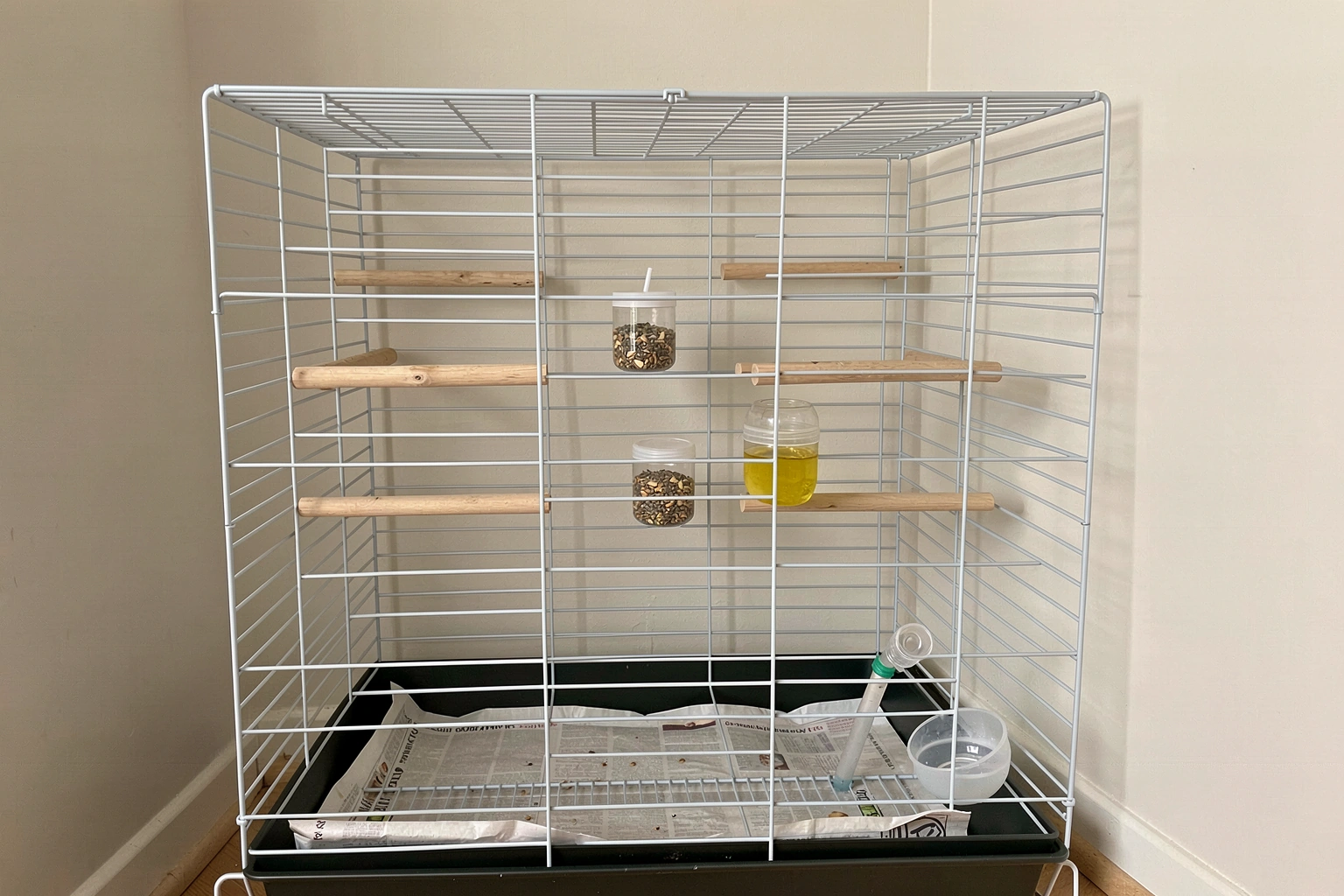
Size is the single most important decision you will make, and the minimum numbers matter. For a budgie specifically, pay close attention to cage size, bar spacing, and placement so your setup supports healthy, low-stress behavior budgies. The Merck Veterinary Manual recommends at least 20 x 20 x 30 inches with bar spacing no wider than 0.5 inches for small birds like budgies, cockatiels, lovebirds, and parrotlets. Best Friends Animal Society cites a similar baseline of 18 x 18 x 24 inches for budgies at absolute minimum. My honest advice: treat those as floors, not targets. A bird that can barely turn around without hitting a toy is a bird that will develop stress behaviors quickly.
Beyond raw dimensions, focus on bar spacing and cage shape. Bar spacing that is too wide lets small birds get their heads stuck, which is a genuine emergency. Avoid round cages entirely: they give birds no corner to retreat to, which causes chronic low-grade stress. A rectangular or square cage with a flat top or play-top design is almost always the better choice. Stainless steel is the gold standard for material because it is non-toxic and easy to disinfect. Powder-coated cages are fine if the coating is confirmed lead-free and zinc-free. Check the manufacturer documentation or contact them directly if you are unsure.
| Bird Species | Minimum Cage Size | Max Bar Spacing |
|---|---|---|
| Budgerigar (budgie) | 18–20 × 18–20 × 24–30 in | 0.5 in |
| Cockatiel | 20 × 20 × 30 in | 0.5–0.6 in |
| Lovebird / Parrotlet | 20 × 20 × 30 in | 0.5 in |
| Conure (small) | 24 × 24 × 30 in | 0.75 in |
| African Grey / Amazon | 36 × 24 × 48 in | 1–1.25 in |
| Macaw (large) | 36 × 48 × 60 in or larger | 1.5 in |
For large birds especially, the cage should be wide enough that the bird can fully extend both wings without touching the sides. If you are setting up for a macaw, cockatoo, or large Amazon, a walk-in aviary or a very large floor-standing cage is worth budgeting for rather than compromising on a cage that is technically too small.
Step-by-Step Natural Setup Basics
Substrate: What Goes on the Cage Floor
Unbleached paper (plain newspaper, kraft paper, or commercial cage liners) is the safest and most practical substrate for the bottom of most cages. It lets you see droppings clearly so you can monitor your bird's health, and it swaps out in seconds. Avoid cedar or pine shavings because the aromatic oils are toxic to birds. Sand paper cage liners sold as perch covers are also a problem: they abrade foot pads and can cause bumblefoot. If you want a more naturalistic look on the floor of a large aviary, clean play sand works, but it requires more frequent raking and replacement to control bacteria.
Cage Placement: Where in the Home
Place the cage against a solid wall on at least one side. This gives the bird a sense of security rather than the exposed, 360-degree vulnerability of a cage in the middle of a room. Keep one corner of the cage in contact with the wall. Height matters too: at eye level or slightly above tends to work well for most companion birds. Too low and they feel vulnerable; too high and they can become territorial.
Stay out of the kitchen. VCA Animal Hospitals is clear on this: cooking fumes, smoke, non-stick cookware off-gassing, and cleaning product residue in the air are genuinely dangerous to birds' respiratory systems. The same goes for bathrooms (cleaning products, aerosols) and rooms where people smoke or use candles, air fresheners, or scented wax. A living room or dedicated bird room with good natural air circulation is ideal.
Airflow: Fresh Air Without Drafts
Birds need fresh air but cannot handle direct cold drafts. Position the cage so it is not directly in front of an air conditioning vent, a frequently opened exterior door, or a window that gets wind blown through it in winter. Cross-ventilation in the room is great. Direct airflow hitting the cage is not. A simple test: hold a thin piece of tissue at the cage location and watch whether it moves consistently from one direction. If it does, shift the cage a foot or two until the tissue barely moves.
Lighting and Day-Night Rhythm
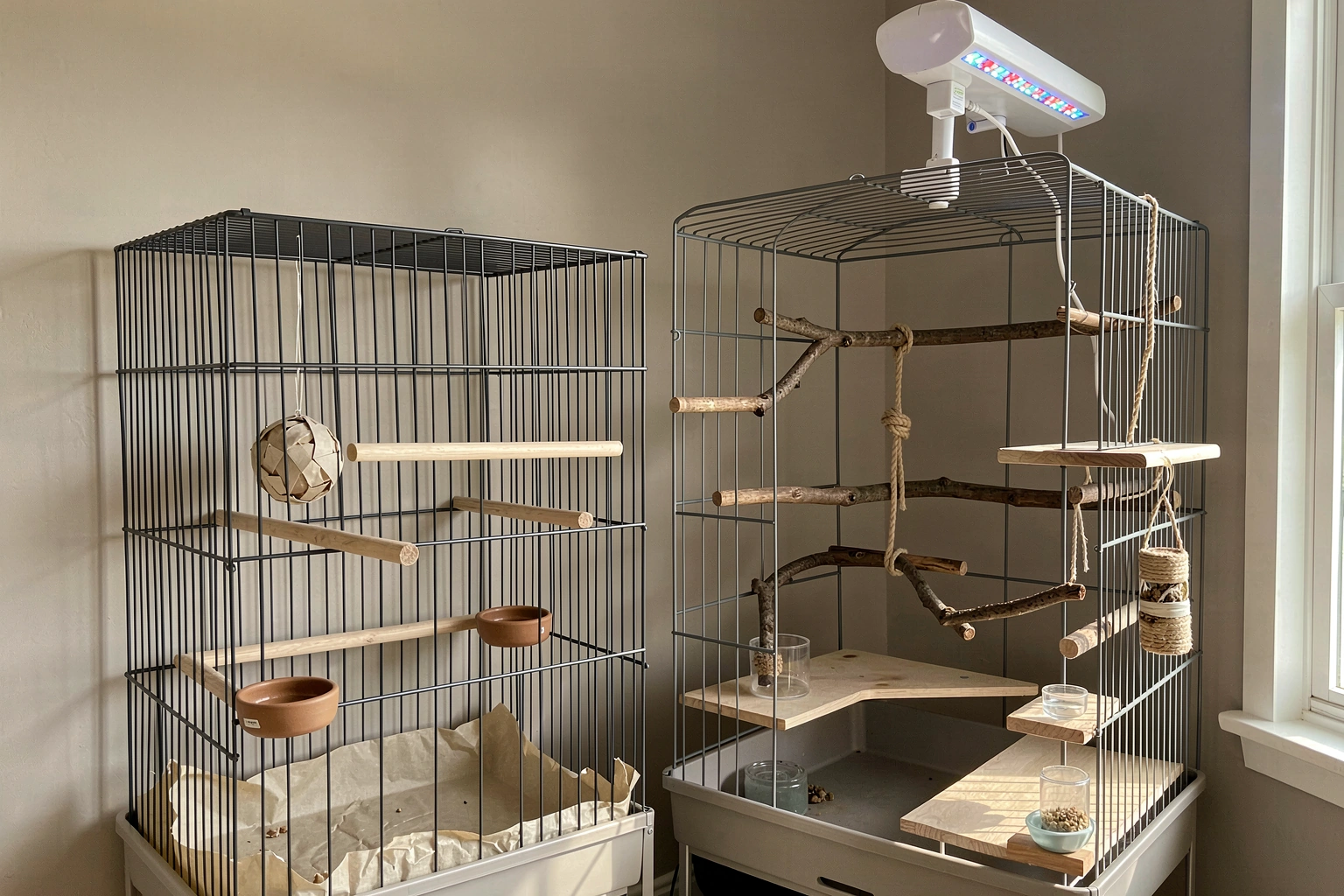
Natural light near a window helps, but it does not reliably provide the full-spectrum UVB exposure birds get outdoors. The Association of Avian Veterinarians points out that window glass filters out most UVB, so birds sitting near a window may not be getting the UVB they need for vitamin D synthesis, especially in winter. Arcadia Bird and similar avian lighting specialists recommend using a dedicated full-spectrum UVB bird lamp positioned within the manufacturer's recommended distance from the cage (usually 12–18 inches) for 4 to 6 hours per day. Check with your avian vet on specifics for your species.
Day-night rhythm is just as important as light quality. Most birds do best with 10 to 12 hours of darkness for sleep. Use a cage cover or manage room lighting consistently so your bird is not kept up by television or bright lights late into the evening. Irregular sleep is one of the most underrated causes of feather-destructive behavior and chronic screaming.
Small Bird Cage Setup: Space Planning and Key Extras
For species like budgies, canary bird cage setup, finches, lovebirds, and parrotlets, the goal is to maximize usable horizontal space. Small birds fly and hop laterally far more than they climb vertically, so a cage that is wider than it is tall serves them better. If you are setting up specifically for budgies or canaries, there are more detailed species-specific guides worth reading alongside this one.
Place perches at two or three different heights but do not overcrowd the cage. Leave clear flight paths so the bird can actually move from perch to perch. A common mistake is filling every inch with toys and perches and then wondering why the bird seems agitated. Aim for perches at a low, middle, and high position. The highest perch is usually where the bird will sleep, so make sure it is stable and away from the cage sides where the bird could scrape its tail.
- Use natural wood perches of varying diameters (0.5–1 inch for small birds) to exercise foot muscles
- Add one rope or soft perch near the sleeping height for comfort
- Include a small foraging toy or treat-hiding toy at mid-level
- Provide a shallow dish of fresh water for bathing, changed daily
- Attach a cuttlebone or mineral block to the cage bars for beak conditioning and calcium
- Keep food and water dishes at mid-height or higher, never directly below a perch where droppings fall
For finches and canaries in particular, keep social needs in mind when planning space. If you want a cage that works well for these social needs, follow a finches bird cage setup checklist for spacing, perches, and enrichment. These birds are happier in pairs or small groups and need enough room that individuals can move away from each other when they choose. If you are housing two or more birds, scale up the minimum cage size accordingly rather than cramming multiple birds into a one-bird minimum setup.
Large Bird Cage Setup: Layout, Perches, Enrichment, and Movement
Large parrots (African Greys, Amazons, cockatoos, macaws, eclectus) need a cage that functions more like a territory than a container. The layout should create distinct zones: a high sleeping perch, a foraging zone, a chewing/destruction zone, and ideally a separate play area on top of the cage or nearby. Think of it like arranging a room rather than decorating a shelf.
Perch variety is critical for large birds. Use natural branches (manzanita, java wood, and apple wood are popular non-toxic options) in at least two different diameters so the bird shifts grip position throughout the day. This reduces pressure sores and keeps foot musculature healthy. A large rope perch or a hanging perch that swings slightly challenges balance and provides enrichment at the same time. Position the main perch at roughly two-thirds of the cage height so the bird feels elevated and secure without having its head and tail cramped against the top and bottom.
Enrichment for large birds needs to be rotated consistently. Foraging toys that require the bird to work for its food (puzzle feeders, wrapped treats, food hidden in crumpled paper) engage problem-solving instincts and prevent boredom-related behaviors like feather destruction and excessive screaming. Rotate at least two or three different toys in and out every week so the environment feels dynamic. Leave one or two familiar items in place at all times so the cage does not feel completely strange after a rotation.
- Use at least three perch types: natural wood branch, rope perch, and a firm platform or corner shelf
- Install foraging stations at different heights: shred paper, use foraging wheels, skewer vegetables on stainless steel skewers
- Include at least one destructible toy made from safe materials like palm fronds, cork, untreated softwood, or leather
- Allow access to a play gym or stand outside the cage daily for at least 2 hours for large parrots
- Provide a large flat-bottomed water dish or hang a shower perch near the cage for bathing opportunities
- Keep food dishes away from droppings zones and anchor them so the bird cannot tip them
Making It the Best: Decorating for Safety and Natural Behavior
Nesting and Resting Spots
For most companion parrots, nest boxes are not recommended unless you are intentionally breeding. Nest boxes can actually trigger hormonal aggression and territorial behavior in non-breeding birds. Instead, offer a cozy covered perch, a sleeping hut made from safe fabric (check that no loose threads can catch toes), or a corner perch with a partial roof. Canaries and finches are the exception: they naturally seek out nesting opportunities and benefit from small nesting cups with safe nesting material like chemical-free coconut fiber.
Foraging Setup
In the wild, birds spend the majority of their waking hours searching for food. In a cage, food delivered to a dish takes seconds. Filling that behavioral gap with foraging is one of the most impactful things you can do. Start simple: wrap a piece of food in unbleached paper, tuck seeds inside a foraging ball, or scatter pellets among safe paper shreds on the cage floor. As your bird gets the idea, increase the complexity. Foraging is also one of the most reliable ways to reduce screaming and feather-destructive behavior in both small and large birds.
Bathing
Most birds bathe regularly given the opportunity, and it supports healthy feather condition and preening behavior. For small birds, a shallow ceramic or glass dish with about half an inch of room-temperature water works well. Place it on the cage floor or on a low perch platform and remove it after an hour so the water does not become contaminated. Large parrots often prefer being misted with a clean spray bottle or bathing in a kitchen sink under a gentle spray. Offer bathing opportunities two or three times per week.
Safe Materials Checklist
- Safe wood species for perches and toys: apple, willow, birch, manzanita, java wood, cork, palm
- Avoid: cedar, pine (aromatic), plywood (glues), pressure-treated wood, painted or varnished wood
- Safe metals: stainless steel, aluminum; avoid zinc and lead in any form (galvanized hardware is often zinc-coated)
- Safe ropes: natural cotton or hemp with no fraying ends that can wrap around toes; replace when fraying starts
- Avoid: any toy with small metal rings or bells a bird can disassemble and swallow, or with chains that can trap toenails
Common Mistakes and Troubleshooting by Size
Small Bird Troubleshooting
Stress from wrong placement shows up fast in small birds. If your budgie, finch, or canary is hiding on the floor, fluffing up during the day, or refusing to eat within the first 48 hours, check placement first. Is the cage in a high-traffic area where people or pets constantly pass by? Is there a dog or cat that sits near it? Move the cage to a calmer wall position and give the bird 48 hours to adjust before drawing any conclusions about its personality.
Boredom in small birds often looks like repetitive pacing, bar-biting, or over-preening. These birds need more stimulation than most people expect. Add a foraging toy or a mirror (for single budgies) and see if behavior shifts within a few days. If you have a single canary or finch and notice persistent lethargy or disinterest, a same-species companion may be the real solution.
Odor and droppings management for small cages is mostly about liner frequency. Change the cage liner daily or every other day at minimum. Wipe down perches weekly with a bird-safe cleaner (diluted white vinegar works and rinses clean). A full cage scrub with a bird-safe disinfectant should happen monthly. If odor persists even with clean liners, check water dishes and soft food remnants, which go bad quickly and are a common odor source.
Large Bird Troubleshooting
Large parrots that are stressed by cage placement often show it through loud vocalizing at irregular times, feather ruffling, or lunging at the cage bars. The most common culprit I see is a cage placed where the bird has no solid wall behind it, or where it is exposed to another animal. Position the cage with at least one solid wall or corner at the bird's back and watch behavior over 24 to 48 hours. Sometimes just rotating the cage so the bird faces the room differently makes a significant difference.
Boredom is a bigger issue for large parrots than almost any other factor in a home environment. If your bird is screaming excessively, chewing cage bars, or showing feather-destructive behavior, the first question is whether it has enough enrichment and enough out-of-cage time. Add foraging opportunities, rotate toys, and increase daily out-of-cage interaction before assuming the bird has a medical or behavioral disorder. If enrichment changes and more social time do not shift the behavior within two to three weeks, an avian veterinarian consultation is the right next step.
Droppings and odor management for large cages require more structure. Use a large-format cage liner (heavy-duty kraft paper rolls cut to size work well) and change it daily. Large parrots produce significant droppings and leftover food debris that builds up fast. Spot-clean the grate below the cage floor daily with a stiff brush. Perches for large birds should be cleaned weekly and replaced when they develop cracks that harbor bacteria. A monthly full disinfection of the cage is non-negotiable. If the room still smells despite clean liner and clean perches, check whether wet or fresh food is being left in dishes for more than a few hours, especially in warm weather.
Perch and Spacing Problems Across Both Sizes
If your bird refuses to use a new perch, it is usually a texture or diameter issue. Introduce new perches gradually by placing them next to a familiar perch so the bird can investigate. If a bird is sitting at the bottom of the cage rather than on perches, check whether the perches are too slippery (common with dowel-style smooth perches), too large in diameter, or positioned in a way that makes the bird feel exposed. Switching to a natural wood branch with variable grip texture usually solves the problem within a day or two.
Give your setup a real evaluation at the end of the first week. Watch where the bird spends most of its time, which perches it uses, whether it is eating and drinking normally, and whether droppings look healthy (formed, not runny, with clear urates). Those five observations tell you more than any checklist. Adjust one variable at a time so you can actually tell what worked. A setup refine over days and weeks is not a one-time project: it is something you refine over days and weeks as you learn your specific bird's preferences.
FAQ
What should I do if my bird is not using the perches in my natural bird cage setup?
If your bird keeps sleeping lower than the top perch, refuses certain perches, or looks “tense” around one specific side, the issue is often perch placement and footing more than cage size. Add a stable, textured perch just below eye level near the preferred “rest zone,” keep the highest perch away from side panels that can scrape tails, and wait 24 to 48 hours after each change before adding more upgrades.
Can I include a nest box or nest hut as part of a natural bird cage setup?
Treat nesting-style items differently from enrichment. For non-breeding parrots, avoid enclosed nest boxes and anything that functions like a protected cavity. If you want a cozy option, choose a sleeping hut or covered perch with limited access and no “breeding den” feel, and remove it if you notice hormonal behaviors like sudden aggression or mounting.
How do I balance foraging toys with daily feeding so my bird still gets proper nutrition?
For most species, you can use foraging daily, but you should not rely on it alone for “enough food.” Offer measured meals or a consistent base diet, then add foraging in place of part of the dish feeding. Start simple (paper-wrapped food, foraging balls), then increase difficulty only after your bird reliably participates without getting frustrated or missing key nutrients.
Is any paper liner safe for a natural bird cage setup, or do I need specific types?
Newspaper or kraft paper can be a safe floor, but not all “paper” products are equal. Avoid ink-heavy glossy inserts, shredded paper that contains dyes or fragrances, and any liner treated with chemicals. Stick to unbleached, plain paper products, and if you use store-bought liners, confirm they are specifically intended for birds and do not include adhesives or scent additives.
Can I use play sand on the bottom of a large aviary for a more natural look?
Yes, but do it strategically. If you want to use sand in a large aviary, plan on higher maintenance, rake daily, and replace more often to prevent bacterial buildup. Keep food off the floor when possible, spot-clean wet areas immediately, and monitor droppings closely during the first two weeks after switching substrates.
What if my bird starts screaming at predictable times, even after I set up the lights correctly?
If your bird is chirping loudly only at certain times, the cause is often lighting and sleep disruption. Confirm you provide a consistent dark period (10 to 12 hours) and cover the cage or reduce late-night TV, bright LEDs, and activity near the cage. If noise continues, check whether the cage is receiving intermittent light from hallways or streetlights through uncovered windows.
How should I position the cage in winter to balance fresh air with draft-free comfort?
For winter, the most important rule is “no direct airflow,” but mild room circulation is still beneficial. Keep the cage out of line with vents, drafty windows, and exterior doors, then improve air quality with stable cross-ventilation in the room rather than blowing air at the bird. Your tissue test helps, repeat it after weather changes because airflow patterns shift.
My bird refuses a new perch. How do I fix the problem without forcing it?
If the bird avoids the new perch, the most common triggers are diameter mismatch, slippery surfaces, or sudden height changes. Introduce new perches next to the old ones, keep the new perch within the bird’s comfort zone for height at first, and choose variable-texture natural branches instead of smooth dowel-style grips. If feet look scaly, red, or “sticky,” switch perch material before continuing.
Do I still need a UVB bird lamp if my bird sits near a window?
Don’t count “UVB near a window” as UVB exposure through glass. If you use a UVB lamp, ensure it is the correct type for birds, place it within the manufacturer’s distance, and keep it on for a consistent 4 to 6 hour window (then off completely for darkness). Watch behavior at the lamp setup, if you see restlessness or panting, stop and reassess placement and heat output.
What are the safest ways to confirm bar spacing is right for my species?
Yes. Some birds can get head injuries if bar spacing is wrong, even if they look “fine” at first. Re-check bar spacing against your species when you set up (especially if you changed cage brands, added a play stand, or relocated toys that make the bird stand closer to the bars). If any part of the bird’s head can reach the bar gap, it is a setup risk that should be corrected immediately.
If my cage still smells bad, what areas should I check first besides the cage bottom liner?
When odor persists after daily liner changes, the culprit is often water and soft food. Dump and scrub water dishes daily, clean around the rim where biofilm forms, and avoid leaving wet foods longer than a few hours. Also check cage tops and toy corners, food crumbs often collect on ledges and rotting matter can drive smell even when the floor liner is clean.
My bird seems stressed during the first two days after the setup. How can I tell if it is placement-related?
If your bird is behaving “worse” in the first 48 hours, it usually indicates placement or environment stress rather than a long-term personality issue. Start by moving the cage to a calmer wall position with a solid back, minimize traffic and pets nearby, then give it a full 48 hours before changing multiple variables at once. Keep handling gentle and predictable during the adjustment window.
For pairs or small groups, how do I prevent resource competition in a natural bird cage setup?
If you have more than one bird, avoid competition by ensuring each bird has access to separate key resources. Plan at least two stations for essentials when space allows (separate feeding positions or feeding routes, and multiple preferred perches at different heights). Even if the cage meets minimums for one bird, crowding can trigger avoidable chasing and resource guarding.
Next Article
Canary Bird Cage Setup: Step by Step Guide for Beginners
Step-by-step canary bird cage setup: size, placement, perches, food and water, cleaning, hygiene, and safe light and air