The Short Answer Before You Buy Anything
For one healthy parakeet, you need a cage that is at least 18 inches wide, 18 inches deep, and 24 inches tall, with bar spacing no wider than 1/2 inch (about 12 mm). That is your non-negotiable minimum. Go bigger whenever you can, because parakeets are active, curious birds that need room to move horizontally, not just sit on a perch. A cage in the 24×18×24 range or larger is a much better starting point if your space and budget allow it.
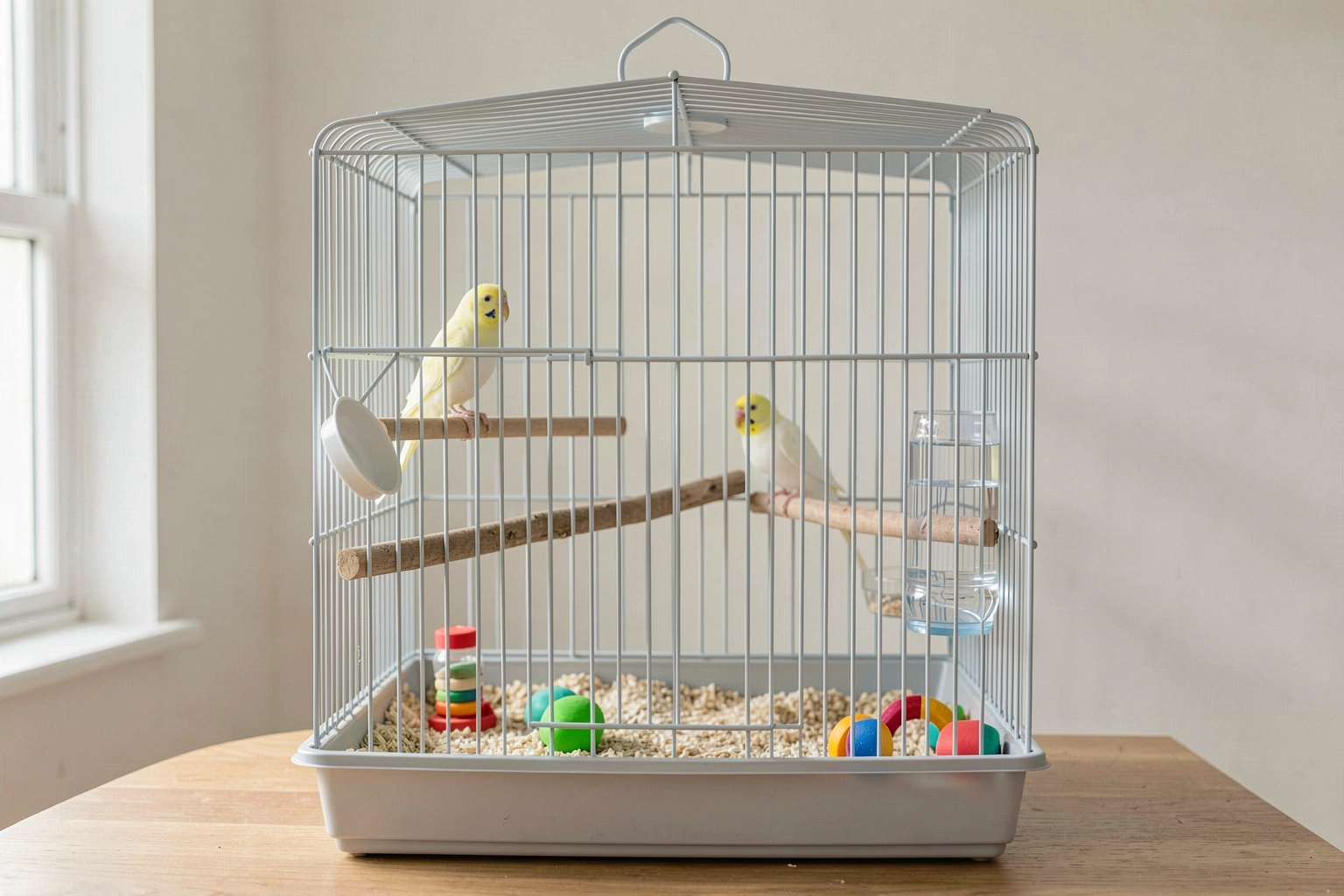
Inside that cage, you need 2 to 4 perches of varying diameters, 2 food dishes and 1 water dish (or a water bottle), 2 to 4 toys, and a clean, safe substrate lining the bottom tray. That is the whole setup. Everything else is an upgrade.
---
Your Quick-Start Shopping List
Before getting into the details, here is what you actually need to buy. Prices are approximate US retail as of early 2026.
| Item | What to look for | Approx. cost |
|---|---|---|
| Cage (18×18×24 min.) | Powder-coated steel, 1/2" bar spacing, slide-out tray | $50–$120 |
| Cage stand (if not included) | Sturdy, matches cage base | $20–$50 |
| Natural wood perches (2–3) | Varied diameters, 3/8"–5/8" thick | $5–$15 each |
| Rope or soft perch (1) | Cotton or sisal, medium diameter | $8–$15 |
| Stainless steel food cups (2) | Hook-on style, easy to remove | $5–$12 each |
| Water dish or bottle (1) | Bottle preferred for cleanliness | $6–$14 |
| Foraging toy (1–2) | Shreddable, no small metal parts | $6–$15 each |
| Bell or swing toy (1) | Bird-safe materials, no zinc or lead | $5–$12 |
| Cage liner paper (pack) | Unscented paper liners or plain newsprint | $8–$15 |
| Bird-safe disinfectant spray | F10SC or diluted white vinegar | $10–$20 |
Total for a solid starter setup: roughly $130, $250 depending on cage size and brand. You can do it for less if you find a good cage secondhand, but inspect it carefully for rust, chipped coating, or bar spacing issues before buying.
---
Cage Size and Bar Spacing: Why These Numbers Matter
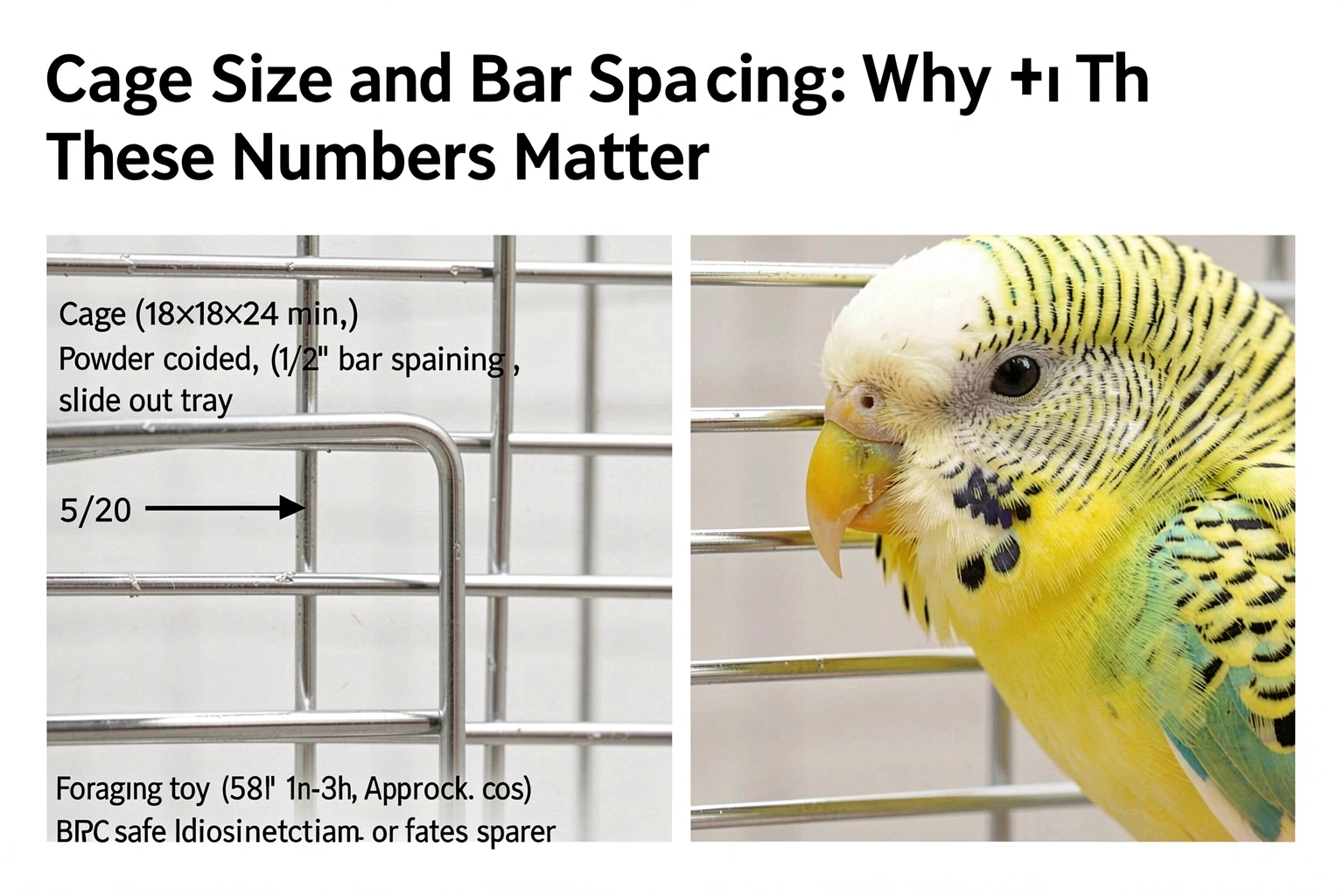
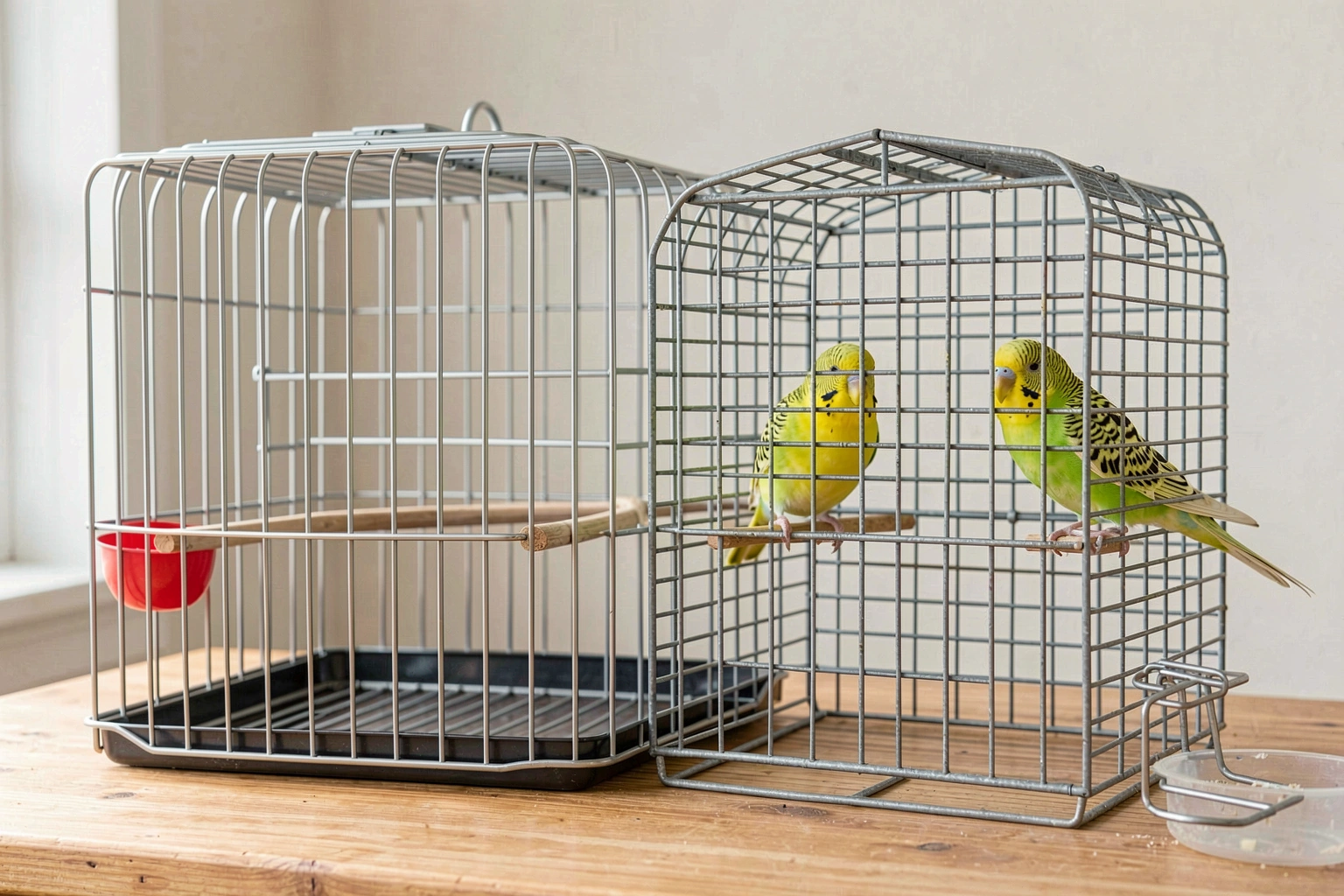
The 18×18×24 minimum is not arbitrary. Parakeets fly horizontally, so width and depth matter more than height. A tall, narrow cage is actually worse than a shorter, wider one. If you are choosing between two cages and one is taller but narrower, take the wider one every time.
Bar spacing is the detail most first-time owners overlook. At 1/2 inch or less, a parakeet cannot get its head stuck between bars. Anything wider than that is a real injury risk. Some cages marketed for small birds still have 5/8-inch spacing, which is too wide. Measure with a ruler before you buy, especially if you are shopping secondhand or from a general pet retailer.
For a second bird, bump up to at least 24×18×24, and ideally larger. Two parakeets need room to establish their own perching spots without constant conflict.
Cage shape and door placement
Rectangular cages are better than round ones. Round cages have no corners, and birds instinctively use corners as safe resting spots. A round cage can cause low-level stress that is hard to diagnose. Stick with rectangular.
Door placement matters for daily handling. A large front door that opens wide makes it easier to reach in for cleaning and to let your bird step up onto your hand. Side doors are useful for attaching food cups without disturbing the bird. If a cage only has one small door, daily interaction becomes a chore.
---
Choosing the Right Cage Material
Powder-coated steel is the standard choice and works well for most owners. It is durable, easy to clean, and widely available. The key is making sure the coating is intact with no chips or rust spots, because bare metal can corrode and the coating itself can be a hazard if it contains zinc or lead. Reputable brands like Prevue Hendryx, Hagen (Vision cages), and A&E Cage Co. use bird-safe powder coatings, so sticking with known brands reduces that risk.
Stainless steel is the gold standard. It does not chip, does not rust, and is completely non-toxic. The downside is cost: a stainless steel cage for a parakeet typically runs $150, $400 or more. If you are planning to keep birds long-term or have a bird with health sensitivities, it is worth the investment. For a first-time owner on a budget, a quality powder-coated cage from a reputable brand is perfectly fine.
Avoid cages with galvanized wire (the dull gray, rough-textured kind). Galvanized wire contains zinc, which is toxic to birds if chewed. Also avoid any cage with a wooden frame or wooden floor panels. Wood absorbs moisture and bacteria, and it is nearly impossible to disinfect properly.
---
Setting Up the Inside of the Cage
This is where most people either get it right or accidentally make their bird uncomfortable for months without realizing it. The layout inside the cage affects how much your bird moves, whether it can eat without stress, and how easy the cage is to clean.
Perches: the most important accessory
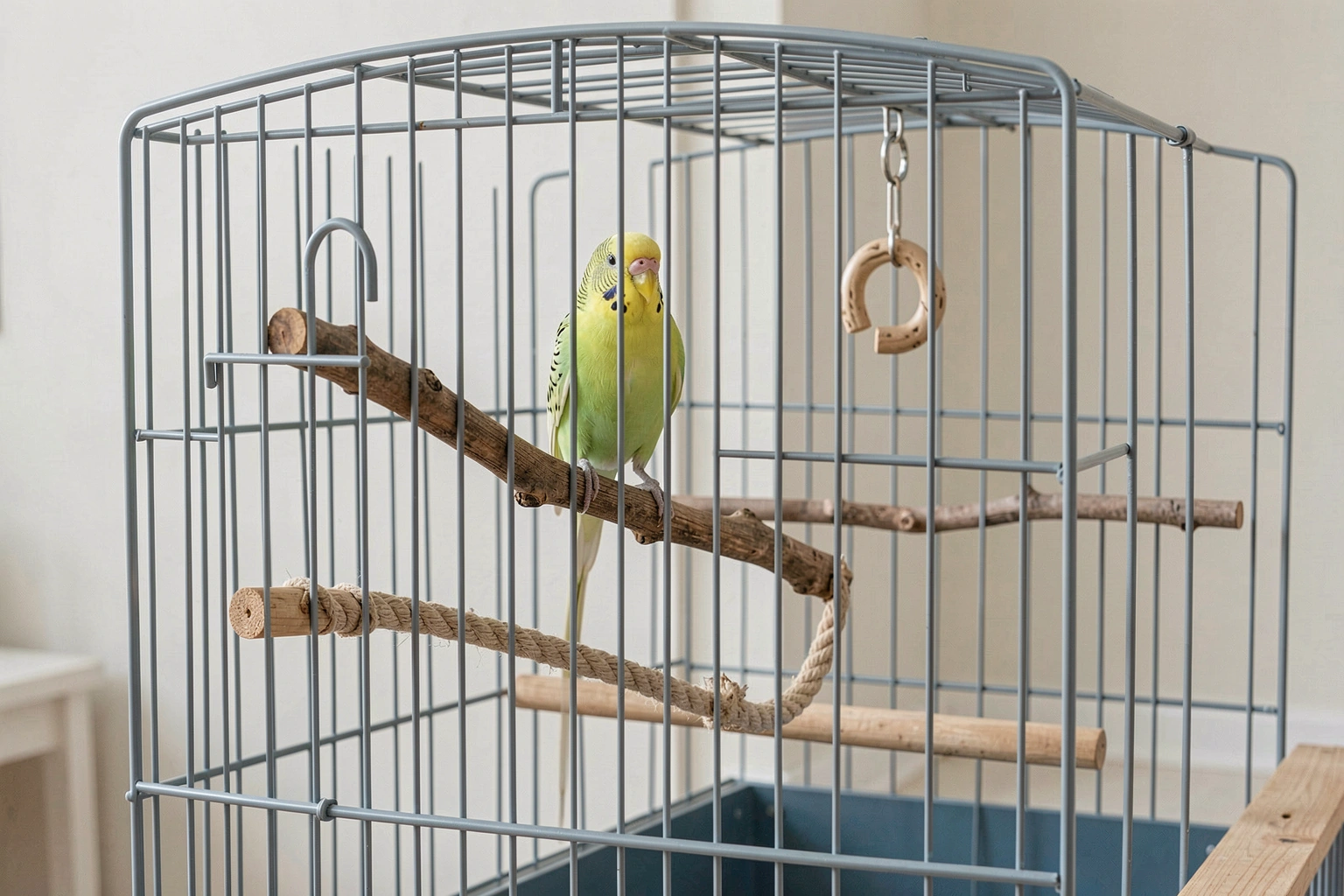
Your parakeet will spend most of its waking life on perches, so this is not the place to cut corners. You want 2 to 4 perches total, and they should vary in diameter and texture. A diameter range of roughly 3/8 inch to 5/8 inch (about 10, 16 mm) is ideal for budgies. If every perch is the same diameter, the bird's feet grip in exactly the same position all day, which can lead to foot soreness over time.
Natural wood perches are the best base. Manzanita, dragonwood, and java wood are all popular, durable, and safe. They have natural variation in diameter along their length, which is exactly what you want. Avoid cedar, eucalyptus, and other aromatic woods, as the oils can irritate a bird's respiratory system.
Add one rope or soft perch (cotton or sisal) for variety, and consider a cement or sandy perch near the food area to help naturally wear down the nails. Do not use sandpaper perch covers. They are too abrasive and can cause foot sores.
Placement: put the highest perch near the top of the cage but not so close to the top that the bird's head touches the ceiling. Place a second perch at a mid-level, and keep the lowest perch well above the cage floor so droppings do not accumulate on it. Never place a perch directly over a food or water dish.
Food and water placement
Two food cups and one water source is the minimum. Use stainless steel hook-on cups if possible. They are easy to remove, easy to clean, and do not absorb bacteria the way plastic does. If you use plastic cups, replace them every few months as scratches harbor bacteria.
Mount food cups at a comfortable mid-height, not at the very bottom of the cage. Birds feel more secure eating at a height where they can see their surroundings. Keep the water source away from perches above it to prevent droppings from contaminating it. A water bottle attached to the outside of the cage bars is actually a cleaner option than an open dish, though some birds take a few days to learn how to use one.
Separate the seed dish from the pellet or fresh food dish. This makes it easier to monitor what the bird is actually eating and prevents wet produce from contaminating dry seed.
Toys: enough to engage, not so many it is cluttered
Two to four toys is the right range for a single parakeet. More than that and the cage becomes crowded and stressful. Less than two and the bird gets bored, which leads to feather plucking and repetitive behaviors.
Include at least one foraging or chew toy (something the bird can shred, pull apart, or manipulate) and one simpler toy like a bell, mirror, or swing. Parakeets are social and curious, and a mirror can help a solo bird feel less alone, though it is not a substitute for real interaction.
Rotate toys every 1 to 2 weeks. Swapping out one toy for a new one keeps the environment stimulating without overwhelming the bird. Keep a small stash of 4 to 6 toys and cycle through them.
Avoid toys with small metal rings, loose threads that can wrap around toes, or any parts made from zinc or lead. Check the packaging for "bird-safe" labeling, and when in doubt, skip it.
Substrate: what goes on the cage floor
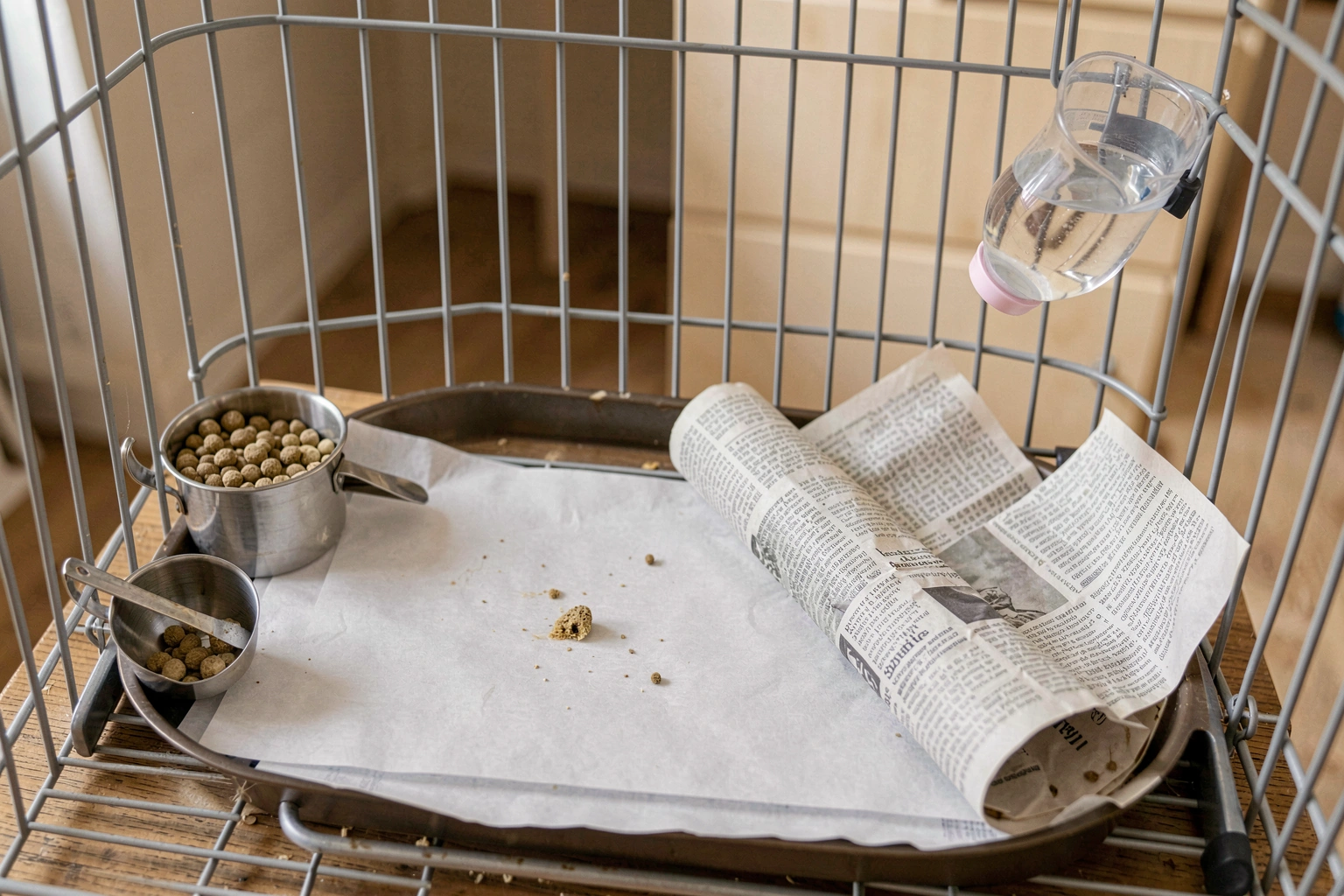
The simplest and safest option is plain paper. Unscented paper cage liners, plain newsprint, or paper towels all work well. They are easy to swap out daily, let you see droppings clearly (which is useful for monitoring health), and do not harbor bacteria the way loose substrates can.
Avoid cedar shavings entirely. The aromatic oils are toxic to birds. Pine shavings are also best avoided. Corn cob bedding and walnut shell bedding can grow mold quickly and are not recommended. Stick with paper and change it daily or every other day.
---
Where to Put the Cage in Your Home
Cage placement is one of the most underrated parts of the setup. A perfect cage in the wrong spot can still make a bird miserable or sick.
Place the cage in a room where the family spends time, so the bird feels like part of the social group. Parakeets are flock animals and get stressed by isolation. A living room or home office works well. Avoid the kitchen entirely. Cooking fumes, especially from nonstick (PTFE/Teflon) cookware, are acutely toxic to birds and can kill a parakeet within minutes of exposure. Even a brief overheating of a nonstick pan in the same airspace is dangerous.
Position the cage against a wall or in a corner so the bird has a sense of security on at least two sides. Do not place it in the center of a room where activity comes from all directions. Keep it away from windows with direct afternoon sun (overheating risk) and away from air vents, drafts, and exterior doors.
Height matters too. The cage should be at roughly eye level or slightly below when you are standing. Too low and the bird feels exposed and anxious. Too high and it may become territorial.
Hazards to remove from the room
Before your bird comes home, do a quick sweep of the room for these common hazards:
- Nonstick cookware or appliances (air fryers, waffle irons, some hair dryers) in the same airspace
- Scented candles, air fresheners, and aerosol sprays
- Electrical cords within reach if the bird is ever out of the cage
- Open water sources (toilets, fish tanks, glasses of water)
- Other pets, especially cats and dogs, that could stress or injure the bird
---
Cage Material Comparison: Which One Is Right for You
| Material | Safety | Durability | Ease of cleaning | Cost | Best for |
|---|---|---|---|---|---|
| Powder-coated steel | Good (if coating intact) | Good | Easy | $ | Most first-time owners |
| Stainless steel | Excellent | Excellent | Very easy | $$$ | Long-term keepers, sensitive birds |
| Galvanized wire | Poor (zinc risk) | Moderate | Moderate | $ | Not recommended |
| Wooden frame | Poor (bacteria) | Low | Difficult | Varies | Not recommended |
For most people starting out, a quality powder-coated steel cage from a reputable brand is the right call. If you are already sure you will keep birds for years and want to buy once, stainless steel is worth the splurge.
---
What to Feed and How to Set Up the Diet
A parakeet's diet should not be 100% seed, even though that is what most pet stores sell. Seeds are high in fat and low in many essential nutrients. A better approach is a mixed diet: roughly 50 to 60 percent high-quality pellets, 20 to 30 percent fresh vegetables and some fruit, and the remainder as seed or millet as a treat.
Good pellet brands for parakeets include Zupreem Natural, Harrison's Bird Foods (fine grind), and Roudybush. Transitioning a seed-only bird to pellets takes patience, sometimes weeks, so do not remove seeds abruptly. Offer pellets in a separate dish and let the bird explore them on its own timeline.
For fresh food, dark leafy greens like kale, romaine, and spinach are excellent. Carrots, broccoli, bell peppers, and cucumber are also good options. Introduce one new food at a time so you can spot any digestive reaction. Avoid avocado, onion, garlic, chocolate, and anything with caffeine or alcohol. These are toxic to birds.
Calcium is important, especially for female parakeets. A cuttlebone clipped to the inside of the cage bars is the easiest way to provide it. Most birds will nibble on it as needed.
Change water daily, every single day. Bacteria grow quickly in a water dish, especially if the bird dunks food in it. If you use a water bottle, rinse and refill it daily and scrub the nozzle weekly.
---
Your 1-Hour Setup Plan
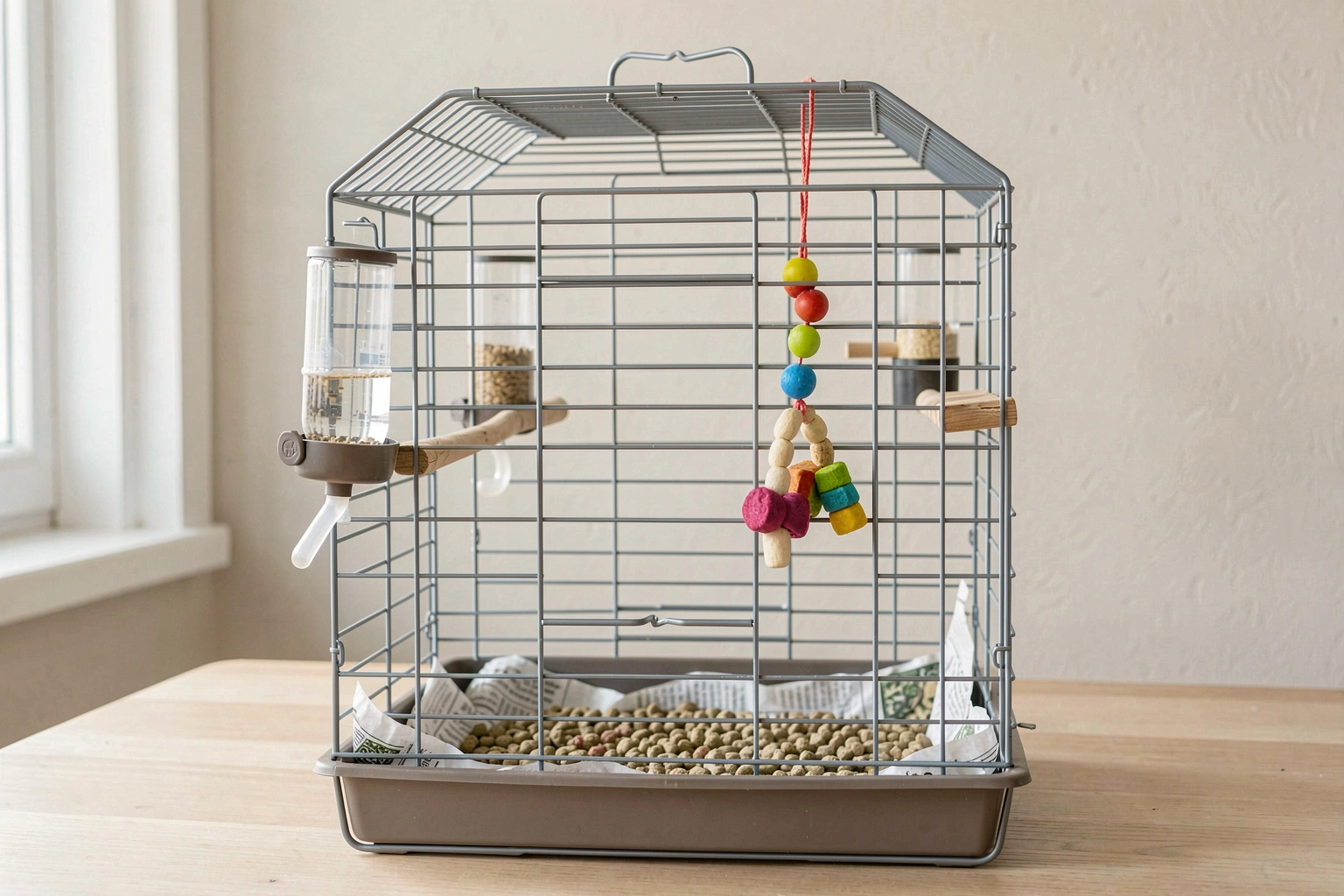
Here is how to go from an empty cage to a ready-to-use setup in about 60 to 90 minutes.
Minutes 0, 15: Inspect and clean the cage. Even a brand-new cage should be wiped down before use. Use a diluted bird-safe disinfectant or a 1:10 bleach-to-water solution, rinse thoroughly, and let it air dry completely. Check every bar for sharp edges, loose welds, or chipped coating.
Minutes 15, 30: Install perches. Start with two perches at different heights. Place the highest one near the top of the cage but with at least 2 inches of clearance above it. Place a second perch at mid-level on the opposite side so the bird has to move to get between them. Secure all perches firmly. A perch that wobbles will stress the bird.
Minutes 30, 40: Attach food and water cups. Mount two food cups at mid-height on the same side of the cage, near a perch but not directly below one. Attach the water bottle or dish on the opposite side or at a different height to keep it clean.
Minutes 40, 50: Add toys. Start with just two toys. Hang one foraging or chew toy near the mid-level perch and one simpler toy (bell or swing) near the top. Leave plenty of open space. The cage should not look cluttered.
Minutes 50, 60: Line the tray and do a final check. Cut paper liners to fit the slide-out tray and lay them flat. Do a final visual check: no perches over food dishes, no toys blocking flight paths, all doors latch securely, no sharp edges or loose parts.
Then let the cage sit empty for a few hours before introducing your bird. This gives any residual cleaning smell time to dissipate.
The 1-week optimization plan
Once your bird is home and settling in, use the first week to observe and adjust. Watch which perch the bird sleeps on (that is the favorite, keep it stable). Notice if the bird is avoiding any toy (remove it). Check whether the water source is being used. By day 7, you will have a much clearer picture of what your specific bird likes, and you can make small adjustments from there.
---
Keeping It Clean: Daily, Weekly, and Monthly
Maintenance is not complicated, but it does need to be consistent. A dirty cage is one of the fastest routes to a sick bird.
Daily (5, 10 minutes): Swap out the paper liner, rinse and refill the water dish or bottle, wipe down food cups with a damp cloth, and remove any uneaten fresh food. Fresh produce left in the cage for more than a few hours can grow mold and bacteria quickly.
Weekly (20, 30 minutes): Remove all perches, toys, and dishes. Wash everything with hot soapy water, then disinfect with a bird-safe cleaner (F10SC diluted per label instructions, or a 1:10 bleach solution with a thorough rinse). Wipe down all cage bars and the tray. Let everything dry completely before reassembling.
Monthly (30, 45 minutes): Do a deeper inspection. Check perches for cracks, splinters, or heavy soiling that will not scrub off. Replace any that are worn. Inspect toys for broken parts, frayed rope, or rust. Rotate in fresh toys from your stash. Check the cage bars and tray for any signs of rust or chipped coating and address them immediately.
For disinfectants, diluted white vinegar (1:1 with water) is a safe, accessible option for light cleaning. For a proper disinfection, F10SC veterinary disinfectant is widely used by avian vets and bird breeders. Avoid bleach-based products near the bird and always rinse thoroughly and allow full drying before the bird goes back in.
---
A Few Mistakes to Avoid
The most common mistake is buying a cage that is too small because it looks fine in the store. A cage that seems roomy on a shelf looks very different once you add perches, toys, and dishes. If you are on the fence between two sizes, always go bigger.
The second most common mistake is placing the cage in the kitchen or near the stove. Even if you never use nonstick cookware, kitchens have more fumes, temperature swings, and cleaning product exposure than any other room. It is not worth the risk.
A lot of new owners also over-accessorize immediately. Adding six toys, four perches, and a bunch of decorations before the bird has even settled in is overwhelming. Start minimal, observe, and add things gradually.
Finally, do not skip the daily water change because it looks clean. Parakeets dunk food in their water constantly, and what looks like clear water can be full of bacteria within hours. Fresh water every day is non-negotiable.
Signs your bird is stressed or unwell
A healthy parakeet is active, vocal, and curious. Watch for these early warning signs that something is off:
- Sitting fluffed up on the cage floor (not just on a perch)
- Tail bobbing with each breath
- Discharge from the nostrils or eyes
- Droppings that are consistently watery, discolored, or very dark
- Sudden loss of appetite or complete silence for more than a day
- Feather plucking or repetitive pacing
Any of these warrants a call to an avian vet, not a wait-and-see approach. Birds hide illness instinctively, so by the time symptoms are obvious, the problem has often been developing for a while.
---
Scaling Up: Small Spaces, Multiple Birds, and Long-Term Upgrades
If you are in a small apartment, the cage size minimum still applies. A 18×18×24 cage is not large in absolute terms, roughly the footprint of a small microwave, so there is almost always room for it. What you can adjust is the stand height and placement to make it work in a tighter space.
For renters concerned about noise, parakeets are genuinely one of the quieter pet bird options. They chirp and chatter but rarely scream. Placing the cage in an interior room away from shared walls helps if noise is a concern.
If you add a second bird, upgrade the cage before the bird arrives, not after. Two parakeets in an 18×18×24 cage will be cramped and may fight over perches and food. A 24×18×24 or 30×18×24 cage gives both birds enough space to establish their own spots. Add a second set of food and water dishes so there is no competition at feeding time.
Long-term, the best upgrade you can make is moving to a larger flight cage (36 inches or more in width) if your space allows. Parakeets that have room to actually fly short distances inside their cage are noticeably more active, healthier, and better-tempered than birds in minimum-size cages. It is not required, but it makes a real difference in quality of life.